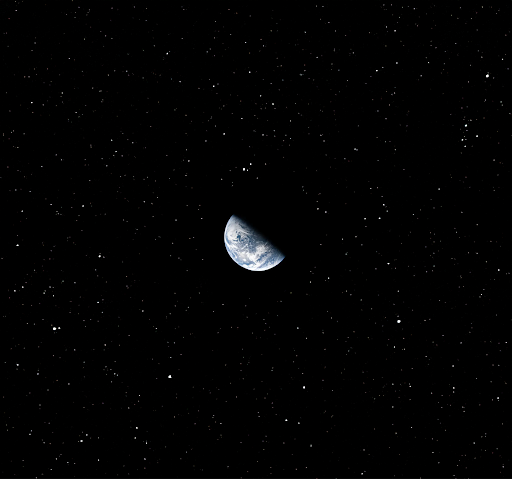
Artemis II returned to Earth as a triumph of engineering, but its deepest meaning may lie elsewhere. After a textbook splashdown in the Pacific, the crew’s first public reflections did not dwell mainly on hardware, precision, or national prestige. Again and again, their words turned toward something more fundamental. They spoke about Earth, about family, about love, about crew, and about the strange immensity of seeing our world set against black space. In that sense, Artemis II was not only a mission around the moon. It was a renewed encounter with the noetic dimension of exploration, the expansion of consciousness that comes when human beings see their world whole.
That idea has a lineage. After returning from the moon on Apollo 14, Edgar Mitchell described a profound shift in awareness, a sense of interconnection so powerful that it reshaped his life and led him to found the Institute of Noetic Sciences.
 “When we were returning, the capsule was spinning back to earth. As we’re spinning, flashing through the window was, the earth, the moon, the sun, the stars… the earth, the moon, the sun, the stars. At that moment, I had a visceral experience more clear than anything I’ve ever known, that the universe was conscious and we were part of that consciousness.”
The Overview Effect: A Reordering of Perception
What later came to be called the overview effect was not simply visual awe. It was a reordering of perception and value. Earth no longer appeared as a collection of rival territories, but as a single living reality, fragile and indivisible. Human consciousness itself seemed to come into view as the deeper reality at the core of that shared world. Artemis II now seems to stand in that same tradition. The Artemis crew returned speaking not in the language of conquest, but in the noetic language of awakening, inner transformation, and belonging.
Reid Wiseman gave perhaps the clearest expression of this transformation. “It’s a special thing to be a human and it’s a special thing to be on planet Earth.” That sentence matters because it is so stripped down. After traveling more than 200,000 miles from home, after participating in one of the most technically demanding missions of the century, he did not reduce the experience to achievement. He reduced it to humanity.
“You Are a Crew”: The Noetic Demand for Interdependence
Christina Koch’s words pushed this insight even further. Reflecting on one of the strongest revelations of the journey, she spoke of seeing Earth small through Orion’s window, suspended in surrounding darkness. From that vision came the sentence that may endure longer than any formal mission summary: “Planet Earth: You are a crew.” This is more than metaphor. It is a noetic proposition. A crew is not merely a set of individuals occupying the same vessel. A crew is bound by mutual dependence, common purpose, silent sacrifice, accountability, and care. Koch had already defined it beautifully: “A crew is a group that is in it all the time, no matter what, that is stroking together every minute with the same purpose, that is willing to sacrifice silently for each other, that gives grace, that holds accountable.” When she turned that definition toward Earth itself, she transformed a mission reflection into a civilizational insight.
Jeremy Hansen articulated the same truth from another angle. Speaking about the public response to the mission, he said, “When you look up here, you’re not looking at us. We are a mirror reflecting you, and if you like what you see, then just look a little deeper. This is you.” Victor Glover’s remarks added another essential dimension, noting that the gratitude was “too big to just be in one body.”
A Shared Vision: Bridging Space Exploration and Planetary Peace
Taken together, these statements suggest that the real achievement of Artemis II may be interior as much as technical. It restored to living experience the sight of Earth from deep space, and with it the possibility of a renewed planetary consciousness. This perception challenges the fragmentation of life on Earth.
At the very moment this crew circled the moon and came home speaking of love, gratitude, and shared purpose, the world remained marked by war. The noetic perspective does not erase conflict or deny injustice, but it does insist on a prior truth: that all such struggles unfold on a single planet inhabited by one human family whose fate is inseparable.
Artemis II brought back more than mission success. It brought back testimony. The crew did not return telling us merely that we can go farther; they returned reminding us what and whom we belong to. That may be the enduring legacy of Artemis II—that from that distance, humanity saw Earth again and briefly recognized itself.
Arnaud Delorme, PhD, is a neuroscientist at IONS and has been studying human consciousness for the last 20 years. He is a CNRS Research Director in Toulouse, France, and a senior Research Scientist at the University of California, San Diego. He is a long-time Zen meditator, and recipient of several research prizes. He is the author of some 160+ peer-reviewed publications, and is best known for his work on the neural correlate of mind wandering and for developing the EEG software that is now the most-used in EEG research worldwide. He is the author of Why Our Minds Wander: Understand the Science and Learn to Focus Your Thoughts.
