Dean Radin, PhD, and the team at the Institute of Noetic Sciences (IONS) are at the forefront of the exploration of consciousness. Have you ever had a strong gut feeling, a premonition, or a sense of connection that seems to defy distance? At IONS, we have spent over 50 years applying rigorous science to these profound, noetic experiences. We invite you to explore the science and join our global community as we re-envision what is possible.
Inspired by Science, Transformed by Experience
Dean Radin on the Joe Rogan Experience
Explore the science of magic and intuition, and join the IONS community.
A Revolution is Brewing
Watch the Full Webinar for Free
Enter your email address to watch the full recording now of a special ConnectIONS Live webinar with Dean Radin on his book The Science of Magic – exploring how consciousness shapes reality and today’s magic becomes tomorrow’s science. We’ll never share your email address and you can unsubscribe any time.
Explore Select IONS Research
Knowing the Future
What it is
Precognition is the ability to gain information about future events before they happen. Unlike presentiment, which is unconscious, precognition involves conscious impressions and insights.
What research shows
For more than a century, laboratory studies have tested precognition. Early forced-choice guessing tasks and later free-response designs both found above-chance results. Implicit precognition studies, including Daryl Bem’s well-known work, suggest that even simple reaction times can be influenced by future events. Historical and cross-cultural accounts also show that premonitions and prophetic dreams have long been part of human experience.
IONS research
IONS has explored laboratory contexts of precognition, including studies where participants attempt to predict future targets or events. While not always replicating across all conditions, these studies contribute to a growing body of evidence suggesting that glimpses of the future may be possible.
References: Honorton et al., 2018; Storm, Tressoldi, & Di Risio, 2012; Mossbridge & Radin, 2017; Storm & Tressoldi, 2020; Bem, 2011.
Our Bodies Know Before Our Minds Do
What it is
Presentiment refers to the body’s unconscious ability to anticipate future events before they happen. Unlike precognition, which involves conscious awareness, presentiment shows up as subtle physiological changes, such as shifts in heart rate, skin conductance, or brain activity that occur seconds before unpredictable, randomly chosen events.
IONS research
- Seeing the Future: Exploring Presentiment with Eye Gaze and Pupillary and Eye Dilation.
- Intuition through time: what does the seer see? (Radin & Borges, 2009).
- Predicting the unpredictable: critical analysis and practical implications of predictive anticipatory activity (Mossbridge, Tressoldi, & Utts, 2012).
What research shows
Dozens of laboratory studies, including multiple meta-analyses, have found reliable presentiment effects. Every day accounts mirror these findings, for example, a sudden feeling that prompts hesitation just before an accident occurs. Such cases suggest our unconscious mind, as reflected in physiological activity, may sometimes register what is about to happen before the events occur.
References: Mossbridge, Tressoldi, & Utts, 2012; Mossbridge et al., 2014; Mossbridge & Radin, 2017; Radin, 2023; Yount et al., 2026 (in preparation).
Accessing Information Through Altered States /
Trance-Channeled Communications Attributed to Extraterrestrial Intelligences (ETIs)
What it is
Trance channeling is a phenomenon in which a person enters an altered state of consciousness and reports receiving information, insights, or messages from a source beyond their ordinary awareness. Experiences range from light trance states, where the individual remains fully aware, to deeper states in which the channeler feels that another intelligence is communicating through them. Trance channeling has been documented throughout history and appears in spiritual, religious, and cultural traditions around the world.
What research shows
Research suggests that trance channeling is more common than many people realize and is generally associated with positive psychological functioning rather than pathology. Studies have found that channelers tend to report greater openness, spirituality, and well-being, while remaining within normal ranges of mental health. Laboratory investigations have identified distinctive brain activity patterns during trance states, including changes in neural connectivity and attention. Other studies have shown that some channelers can provide information under controlled conditions at levels exceeding chance expectations, although findings vary depending on the task and testing environment.
IONS research
IONS has conducted one of the most comprehensive scientific research programs on trance channeling to date. Our studies have examined who channels, how channeling is experienced, its physiological correlates, and whether channeling can produce accurate or useful information. EEG studies have revealed distinct neural patterns during trance states, while surveys and interviews have helped characterize the wide range of channeling experiences.
Most recently, IONS has explored trance-channeled communications attributed to extraterrestrial intelligences (ETIs). In retrospective analyses, AI-assisted comparisons found meaningful thematic overlap between channeled ETI communications and hundreds of thousands of pages of UFO and ET-related records, particularly on topics such as consciousness, psi abilities, and nonlinear time. Building on this work, IONS conducted the first prospective study of ETI trance channeling under standardized research conditions. Independent channelers were asked the same questions about extraterrestrial civilizations, consciousness, technology, and humanity’s future. Computational and qualitative analyses revealed moderate to high consistency across channelers, with recurring themes involving interconnectedness, consciousness as a fundamental aspect of reality, multidimensional understandings of space and time, and the development of human potential. These studies do not establish the objective reality of ETIs, but they do demonstrate that trance-channeled communications can exhibit measurable structure, coherence, and consistency when examined scientifically.
Wahbeh, H., Carpenter, L., & Radin, D. (2018). A mixed methods phenomenological and exploratory study of channeling. Journal of the Society for Psychical Research, 82(3), 129–148.
Wahbeh, H., Cannard, C., Kriegsman, M., & Delorme, A. (2023). Evaluating brain spectral and connectivity differences between silent mind-wandering and trance states. In A. Delorme & H. Wahbeh (Eds.), Progress in Brain Research (Vol. 275, pp. 165–191). Elsevier. https://doi.org/10.1016/bs.
Wahbeh, H., Cannard, C., Okonsky, J., & Delorme, A. (2019). A physiological examination of perceived incorporation during trance. F1000Research, 8, Article 67. https://doi.org/10.12688/
Wahbeh, H., Glick, B., Taddeo, S., Brinsmead, E., & Wood, R. S. (2025). Semantic correspondence between trance-channeled ET messages and ufological records. Figshare. https://doi.org/10.6084/m9.
Wahbeh, H., & Glick, B. (2026a). Semantic structure and correspondence in prospective trance-channeled communications attributed to extraterrestrial intelligences. World Futures. Advance online publication. https://doi.org/10.1080/
Wahbeh, H., & Glick, B. (2026b). Qualitative structure and meaning in prospective trance-channeled communications attributed to extraterrestrial intelligences. World Futures. Advance online publication. https://doi.org/10.1080/
Wahbeh, H., Speirn, P., Pederzoli, L., & Tressoldi, P. (2023). Channelers’ answers to questions from scientists: An exploratory study. Journal of Scientific Exploration, 37(3), 443–469. https://doi.org/10.31275/
Mind-to-Mind Communication
What it is
Telepathy is the direct exchange of thoughts or feelings between people without using the ordinary senses. Many people report such moments in daily life—knowing who is calling before answering the phone, or sharing the same thought with a friend at the same time.
What research shows
Experiments have repeatedly tested this phenomenon. In “telephone telepathy” trials, people guessed callers at rates above chance, especially when the caller was familiar (Sheldrake, 2015). The ganzfeld technique—where one person “sends” information while the other is in a reduced-sensory state—has produced some of the most reliable telepathy findings in parapsychology. Dream-ESP studies also show that information can be shared between sender and receiver during sleep.
IONS research
IONS has conducted large-scale studies testing whether participants could sense who was about to call them. In trials where the caller was chosen beforehand, accuracy was significantly above chance, particularly when participants sent positive intentions toward the caller. In trials where the caller was chosen afterward (a precognition condition), accuracy did not exceed chance. Genetic relatedness predicted higher accuracy, suggesting family bonds may strengthen telepathic effects (Wahbeh et al., 2024). Ongoing studies are testing highly connected pairs—including twins and bonded couples—as well as new ganzfeld experiments with updated methods.
References: Sheldrake, 2015; Storm, Tressoldi, & Di Risio, 2010; Baptista, Derakhshani, & Tressoldi, 2015; Krippner, 2005; Storm & Rock, 2015; Storm et al., 2017; Wahbeh et al., 2024.
Does Awareness Continue After Death?
What it is
The question of whether consciousness survives physical death is one of humanity’s oldest and most profound. Across cultures and traditions, people have reported experiences suggesting ongoing awareness—such as near-death experiences (NDEs), after-death communications (ADCs), mediumship, and reincarnation memories.
What research shows
Studies across these domains converge on a consistent picture: survival-related experiences are common, often verifiable, and deeply meaningful. NDEs provide one compelling line of evidence, while mediumship research shows above-chance accuracy under blinded conditions. Children who recall past lives have provided historical details later verified. Surveys reveal that large portions of the population—sometimes more than 40%—report after-death communications.
IONS research
At IONS, survival of consciousness is a core research theme. Our work includes:
- Comprehensive reviews (e.g., the BICS Survival Essay) synthesizing evidence from NDEs, mediumship, reincarnation, and ADCs.
- Belief surveys showing that survival beliefs are widespread, with cultural and experiential predictors (Wahbeh & Radin, 2025).
- Academic perspectives research, which found that NDEs, mediumship, and reincarnation are seen as the most persuasive forms of evidence (Wahbeh, 2023).
- Controlled mediumship studies showing above-chance accuracy and distinct brain activity patterns (Delorme et al., 2013, 2018, 2020).
- Mechanism-focused research exploring whether survival-related phenomena point to consciousness as more than an emergent property of the brain (Wahbeh, 2022).
Looking ahead
While no single line of evidence is definitive, together they invite a serious scientific reconsideration of whether consciousness might continue beyond the body.
References: Stevenson, 2001; Beischel, 2012; Delorme et al., 2013, 2018, 2020; van Lommel et al., 2001; Parnia et al., 2014; Wahbeh, 2022; Wahbeh & Radin, 2025.
Near-death experiences are one of the strongest examples of survival-related phenomena.
Seeing Beyond Space and Time
What it is
Remote viewing is the practice of gaining information about distant or hidden targets, or future events, without using the ordinary senses. Popularized by the U.S. government’s Star Gate program (1972–1995), remote viewing is a term associated with a training program, but the phenomenon is nearly identical to the more traditional term, clairvoyance. Clairvoyance is a broad category of psychic sight, while remote viewing could be considered clairvoyance, it distinguishes itself with specific often structured techniques and practices.
What research shows
Declassified documents from Star Gate report that 89% of remote viewing missions produced actionable intelligence (May & Marwaha, 2018). Meta-analyses and independent studies of laboratory studies show robust above-chance accuracy, with effects independent of distance or time (Targ, 2019). Applications range from archaeology to finding missing persons to financial forecasting.
IONS research
IONS is advancing remote viewing research through the OMNI (Open Multidimensional Normed Images) Dataset, developed by IONS and colleagues, with nearly 3,000 images rated on 18 characteristics. It is designed to provide a way to systematically test which image features are associated with accurate viewing. This target set will help to develop more efficient remote viewing experiments and may reveal insights into the underlying mechanisms.
References: May & Marwaha, 2018; Targ, 2019; Baptista, Derakhshani, & Tressoldi, 2015; Cardeña, 2018; Dunne & Jahn, 2003; Milton, 1997; Schwartz, De Mattei, & Smith, 2019; Smith, Laham, & Moddel, 2014.
Windows Into Future Possibilities
What it is
Dreams are among the most common ways people report accessing noetic information, insights that seem to reach beyond ordinary time and space. Precognitive dreams, in particular, occur when elements of a dream later play out in waking life, often producing a powerful sense of déjà vu. Surveys and historical accounts show that such experiences have been reported across cultures for centuries.
What research shows
Dreams appear especially conducive to precognition because the sleeping state reduces the filtering of subtle impressions. Eleanor Sidgwick, a pioneering 19th-century researcher, found that two-thirds of precognitive impressions in her sample arose during dreams. Meta-analyses of “dream ESP” laboratory studies confirm that dreamers can describe randomly chosen future images at rates above chance (Storm et al., 2017). IONS research further supports that precognitive elements are widespread in dreams, with hundreds of spontaneous cases reported through the Noetic Experience Archive (NEXA).
IONS research
The Noetic Signature Inventory (NSI), developed at IONS, shows that dreaming is a distinctive pathway for receiving noetic information, with high variability across individuals. Ongoing work explores how dream-based intuition relates to other forms of channeling and precognition. IONS continues to collect dream reports through NEXA, building a growing dataset for scientific study.
References: Sidgwick (in Alvarado, 2008); Mossbridge & Radin, 2017; Storm et al., 2017; Wahbeh et al., 2022; Wahbeh & Kriegsman, 2023.
Awareness Within the Dream
What it is
Lucid dreaming occurs when a person becomes aware they are dreaming while still in the dream state, often with the ability to influence the dream’s events. This occurs because parts of the brain responsible for self-awareness and decision-making remain active during REM sleep. Techniques like dream journals, reality checks, and the “wake back to bed” method can increase the likelihood of experiencing a lucid dream. Surveys suggest that over half of people have had at least one lucid dream, while a smaller percentage experience them regularly. Traditions such as Tibetan dream yoga have long explored lucid dreaming as a pathway for insight and transformation, and modern science is beginning to investigate its therapeutic potential.
What research shows
Lucid dreams most often occur during rapid eye movement (REM) sleep and are associated with increased activity in brain regions linked to self-awareness and executive control. Laboratory research has shown that lucid dreamers can perform intentional actions, such as eye movements, that can be measured during sleep. Clinical studies indicate that lucid dreaming practices may reduce nightmare frequency and distress, and early trials suggest possible benefits for depression and anxiety as well.
IONS research
IONS has pioneered work testing lucid dreaming as a healing tool for people with posttraumatic stress disorder (PTSD). In a pilot study, participants in a six-day online lucid dreaming workshop reported significant reductions in PTSD symptoms, nightmares, and negative emotions, along with improvements in well-being. A subsequent randomized controlled trial confirmed these findings, showing sustained benefits at one-month follow-up. Interestingly, symptom improvements were not solely explained by achieving lucid dreams, suggesting that the combination of dream practices, mindfulness, group support, and psychoeducation contributed to healing. Future research will refine the workshop, expand to larger populations, and develop therapist training modules. With its accessibility and low cost, lucid dreaming may one day become a practical tool in mainstream trauma care.
“Decreased PTSD symptoms following a lucid dreaming workshop: A randomized controlled study“, published in the European Journal of Trauma and Dissociation.
References: LaBerge, 1985; Voss et al., 2009; Holzinger et al., 2020; Sackwild & Stumbrys, 2021; Yount et al., 2023; Yount et al., 2025.
Our research goal: a deeper understanding of the true nature of reality

Join our Global Community
Learn about the latest research, news, and events from IONS. We’ll never share your email address and you can unsubscribe any time.
Share Your Thoughts in the Comments
Our team will be actively engaging in the YouTube comments over the coming days — welcoming newcomers, joining the discussion, and listening to what resonates.
If something in the conversation lands for you — a specific experiment, a profound implication, a question Joe didn’t get to — share it in the comments. Your voice is part of how this conversation deepens. We will incorporate your thoughts and ongoing questions into a future ConnectIONS Live webinar with Dean Radin and more members of our science team.
About Dean Radin
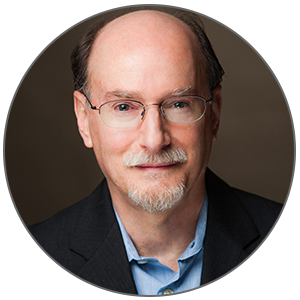
Dean Radin, MS, PhD, is Chief Scientist at the Institute of Noetic Sciences and Associated Distinguished Professor at the California Institute of Integral Studies. He was awarded an Honorary DSc in yoga research from S-VYASA. Before joining the research staff at IONS in 2001, he held appointments at AT&T Bell Labs, Princeton University, University of Edinburgh, and SRI International. Dr. Radin is author or coauthor of hundreds of technical articles, some 175 peer-reviewed journal articles, four dozen book chapters, and five best-selling, popular books. He has given over 850 invited presentations and interviews for government, military, business, scientific, and other groups around the world.
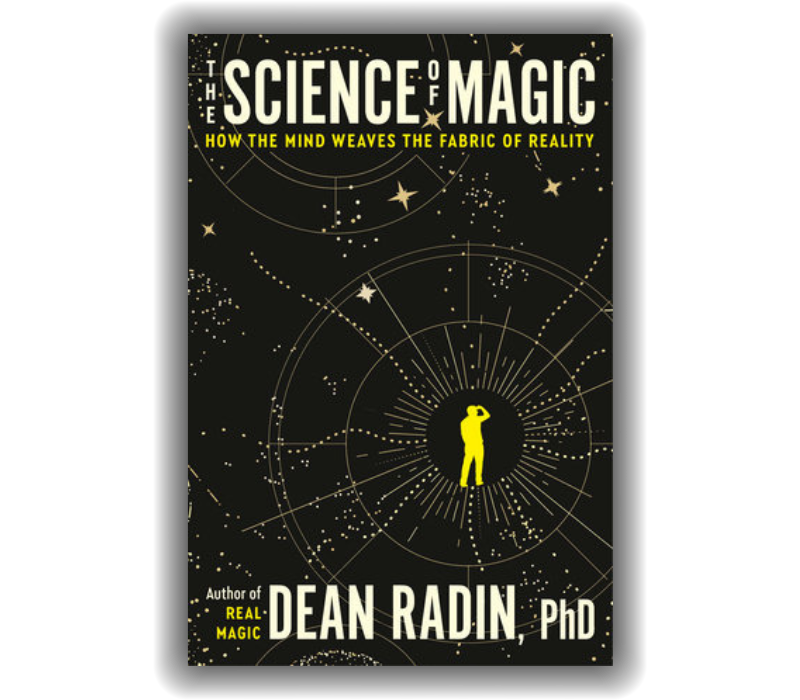
Implement Magic in Your Life
Accessible and practical, The Science of Magic offers magical methods from the perspective of a scientist, demonstrating how to effect change with exercises and hands-on techniques. In short, magic is a mental skill, like meditation or mathematics. You will find a quiz to discover your natural talents and foundational activities for strengthening your skills, including: affirmations (word magic), sigils, knots, candle magic, writing magic, and spell-casting.
Find Your Spark
See yourself – and the world – with newfound clarity. Our programs directly connect you to noetic experiences and help you deepen your journey, wherever you are on your path.
