Our minds spend nearly half of our waking lives wandering—planning, remembering, worrying, imagining, and rehearsing. While this wandering can fuel creativity and insight, it can also contribute to stress, distraction, rumination, and emotional suffering. The good news is that the wandering mind is not a flaw to eliminate—it is a natural feature of consciousness that can be understood, trained, and transformed.
Your mind is always moving—but does it have to control your life?

Course Overview
In this engaging nine-module course, neuroscientist Arnaud Delorme, PhD combines cutting-edge cognitive neuroscience, psychology, contemplative traditions, and practical exercises to help you better understand how your mind works. You’ll discover why thoughts arise, how attention shapes experience, what happens in the brain during mind wandering, and how evidence-based practices—including mindfulness, cognitive reframing, meditation, and body-based approaches—can cultivate greater clarity, resilience, and well-being. Each module concludes with a guided experiential practice designed to help you apply the concepts directly in your own life.
Modules
Understanding Your Wandering Mind
Discover what mind wandering is, why it occurs, and how spontaneous thought shapes nearly half of our conscious lives. Learn how the wandering mind evolved, when it serves us, and when it begins working against us.
The Self and Consciousness
Examine how your sense of self is constructed through ongoing mental narratives. Explore different perspectives on consciousness and investigate how awareness can exist independently from the stories the mind continually creates.
Mapping the Inner World
Learn to recognize different categories of thought—including intentional thinking, spontaneous thinking, rumination, and externally driven attention—and develop a practical map for understanding your own mental landscape.
What Drives Our Wandering Mind?
Explore the emotional, evolutionary, and environmental forces that pull attention away from the present moment. Understand why certain thoughts recur and how internal and external triggers shape mental habits.
Brain on Autopilot
Take a tour of the neuroscience of mind wandering, including the Default Mode Network and the brain systems responsible for attention, memory, and internal thought. Learn how the brain naturally alternates between focused attention and spontaneous cognition.
The Wandering Mind’s Impact on Well-being and Personality
Examine how mind wandering influences happiness, creativity, personality, aging, memory, and emotional health. Learn why the content of our thoughts often matters more than simply whether our minds wander.
Reframing Thoughts and Cultivating Awareness
Discover practical methods for transforming habitual thinking using cognitive reappraisal, Cognitive Behavioral Therapy (CBT), Acceptance and Commitment Therapy (ACT), and mindfulness-based awareness. Learn to recognize thoughts without becoming identified with them.
Beyond Thought
Learn meditation and embodied practices that help loosen the grip of repetitive thinking. Explore focused attention, open monitoring, loving-kindness meditation, somatic awareness, Byron Katie’s The Work, and body-centered approaches that cultivate deeper presence.
Cultivating Well-being
Bring everything together into a sustainable practice for long-term mental well-being. Explore advanced approaches including EMDR concepts, EFT tapping, biofeedback, and practical tools for creating lasting shifts in attention, resilience, and happiness.

Bonus Modules
Bonus Module 1 — Mind-Wandering and Consciousness: Scientific and Contemplative Views
Compare contemporary cognitive science—including Global Workspace Theory and the Self-Organizing Consciousness model—with contemplative perspectives from Rupert Spira and non-dual philosophy. Explore different ways of understanding awareness, ego, and the nature of thought.
Bonus Module 2 — Brainwave Activity and Mediumship
Explore groundbreaking EEG research investigating the neural correlates of mental mediumship. Learn how scientists study unusual states of consciousness and what this research may reveal about attention, awareness, and exceptional human experience.
This Course Includes
Experiential Practices
- Observing spontaneous thought
- Developing meta-awareness
- Attention training
- Mindfulness meditation
- Cognitive reframing
- Acceptance and Commitment Therapy (ACT)
- Somatic awareness
- Body-based releasing techniques
- Loving-kindness meditation
- Byron Katie’s inquiry process
- EFT-inspired practices
- Awareness-based contemplations
Participants Will Learn To...
- Understand why the mind naturally wanders
- Recognize different patterns of thinking and attention
- Identify habitual mental loops before they become automatic
- Strengthen focus without suppressing thought
- Reduce rumination and repetitive thinking
- Apply evidence-based cognitive and mindfulness techniques
- Develop greater emotional resilience
- Improve attention, clarity, and self-awareness
- Cultivate a healthier relationship with thoughts
- Build sustainable practices that support long-term well-being

By the End of This Course...
Rather than trying to stop the mind from wandering, you’ll understand how to work with it skillfully. You’ll develop a deeper appreciation for how attention shapes experience, learn practical tools for navigating difficult thoughts with greater ease, and cultivate a more spacious relationship with your inner life. The result is greater clarity, resilience, and well-being—not by eliminating thought, but by transforming your relationship to it.
Course Developer
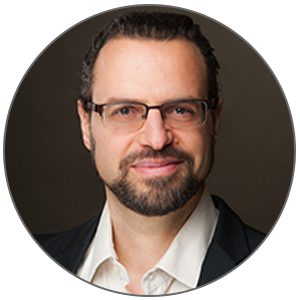
Arnaud Delorme, PhD has been studying human consciousness for the last 20 years. He is a neuroscientist at IONS, a CNRS Research Director in Toulouse, France, and a senior Research Scientist at the University of California, San Diego. In 2000, Dr. Delorme completed his PhD thesis on visual categorization in humans, monkeys, and machines. Dr. Delorme then moved to the Salk Institute for a postdoc in Terry Sejnowski and Francis Crick’s laboratory where he focused on statistical analysis of electroencephalographic (EEG) signals recorded during various cognitive tasks. He developed the free EEGLAB software for advanced analysis of EEG signals in collaboration with Scott Makeig, software which is now amongst the most used in EEG research worldwide. He was awarded a Brettencourt-Schueller young investigator award and a 10-year anniversary ANT young investigator award for his contributions to the field of EEG research.
Dr. Delorme has a keen interest in the scientific study of consciousness and spirituality. He is a long-time Zen meditator, and has taught in India on the neural correlates of conscious experience in a Master’s degree program for the Birla Institute of Technology. Starting in 2002, he started to look at brain dynamical changes underlying extraordinary states of consciousness, including meditation, psycho-active agents, and mediumship.
The author of over 160 publications, Delorme’s work on mediumship is of particular interest — even with the mainstream. His paper on evidential mediumship and the brain activity of mediums is among the top 1% of articles viewed on the Research Gate platform. Backed by research that spans a decade, Delorme has made a compelling argument that the topic of mediumship is worthy of scientific investigation. He is also the author of Why Our Minds Wander: Understand the Science and Learn to Focus Your Thoughts.
Dr. Delorme is also investigating the means by which technology, in particular multi-channel neurofeedback, could be used to assist meditation practice.
You May Also Be Interested In the Book
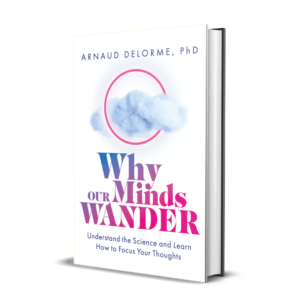
The course pairs perfectly with Arnaud’s book Why Our Minds Wander: Understand the Science and Learn How to Focus Your Thoughts. Backed by science, Arnaud offers easy techniques that will enable you to develop the skill of mind wandering to improve your mood and foster greater creativity. Hear what others have to say about the book.
The Taming the Wandering Mind: Cultivating Clarity and Focus online course allows Arnaud to dive even more deeply into some of the elements contained in the book, through robust lectures and course-specific experiential practices.
