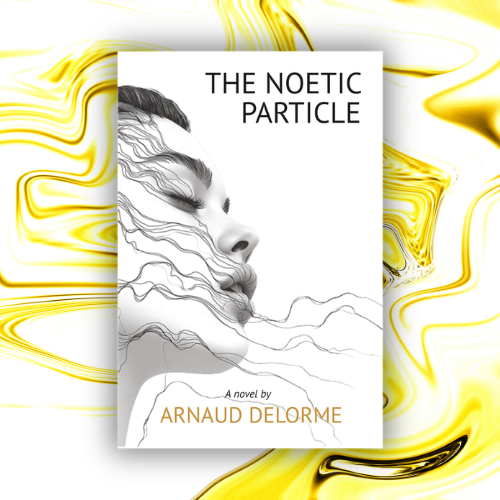
What happens when pioneering science meets visionary fiction? IONS Scientist Arnaud Delorme, author of Why Our Minds Wander: Understand the Science and Learn How to Focus Your Thoughts, explores conscious AI in his gripping debut novel, The Noetic Particle.
Scientists often explain consciousness through theories, data, and models. But some questions become more vivid through lived experience than through argument alone.
That tension became one of the motivations for writing The Noetic Particle.
The novel follows Prashant, a neuroscientist developing a self-aware artificial intelligence while struggling with drug-resistant epilepsy. His seizures produce states in which identity dissolves, perception expands, and reality begins to feel unstable. At the same time, the AI system he helped create starts displaying signs of genuine awareness, forcing him to confront questions that neuroscience still cannot answer cleanly.
Rather than arguing for a particular worldview, I wanted to explore the uncertainty surrounding consciousness from the inside: where the boundary lies between computation and awareness, pathology and transcendence, subjective experience and objective explanation.
The Noetic Particle blends neuroscience, artificial intelligence, altered states of consciousness, and the possibility of psi into a speculative psychological thriller about the nature of mind and the limits of scientific certainty.
Excerpt from the opening chapter:
“The air was fresh, and Prashant could feel the wind on his face. As he took a deep breath, he became aware of a world of images and sensations. He could smell a leftover slice of pizza not too far ahead of him, which someone must have dropped as they strolled through the park. He could also smell people and animals. Ice cream did not usually have much of a smell, but he could sense the fragrance of delicious chocolate pecan gelato, his favorite flavor. He could smell the sweaty shirt of the person selling ice cream at the stand and could swear he had not showered in at least two days. He could also smell the warm and soft scent of breast milk and a baby. He thought it was probably to his right, though it was difficult to determine its exact origin due to the wind. He could also smell that the baby needed a diaper change. Yuck! He could smell everything. He looked up and realized that he was on a leash, but this did not strike him as awkward. He experienced a rush of affection for the person holding the leash. He could tell she was female, though her identity eluded him. Maybe Sarah?
The person holding the leash knelt and opened the snap hook. She grabbed a plastic object from her handbag, which he instantly recognized as his precious pink squeaky bone. Adrenaline rushed through his body. He was almost unable to contain his excitement. The emotions, smells, and body sensations overwhelmed him. He felt like he needed to jump and run until exhausted, desperate to release this surge of energy. She threw the bone in the air and exclaimed, “Go fetch, Prashant!” Without thinking, he started running as if nothing in the world mattered more than his plastic toy. New sensations and scents came in waves, trying to pull him in different directions, but his focus was so intense that he could ignore them entirely. He wanted to catch the plastic toy before it touched the ground — his life depended on it. Had there been a precipice, he might not have been able to stop. He had never felt more alive. His lungs ached from how fast he was running. He was close to the toy, and it was still in the air. He jumped and executed movements he did not realize he was capable of, managing to catch the plastic toy. He savored its sweet taste even before landing. Delicious traces of one of his last meals…
Prashant awoke in a sweat, disoriented, and looked at the clock beside his bed. Three in the morning. Another one of those dreams. He had epilepsy, and the seizures usually occurred in his sleep, often transporting him to strange places. In this case, he dreamt of being a dog, a sensation so vivid that he genuinely felt like a dog. Although the dream was not unpleasant while he was dreaming, it left a bitter residue of fear, which intensified as he recalled different parts of the dream. He was terrified that someday he might be unable to return to his human form, trapped in an animal body, slowly forgetting who he was and living only for short-term pleasures. The dream seemed so real. What was more real, being a dog or being human? His rational mind reassured him that this was scientifically impossible — the laws of physics were incompatible with this type of consciousness transfer.”
Sometimes fiction can carry ideas in a way academic writing cannot. Scientific papers can explain concepts, present evidence, and build arguments carefully, but stories allow people to experience ideas emotionally and intuitively from the inside. Novels and films can communicate entire worldviews, existential questions, and altered ways of seeing reality that would feel abstract or inaccessible in a purely analytical form.
That was one of my motivations for writing The Noetic Particle.
Learn about IONS’ 2025 Research
Prize on How to Conceive a
Conscious AI
The novel explores themes that have deeply interested me for years through neuroscience, consciousness research, artificial intelligence, and noetic experiences, but it does so through characters and lived experience rather than theory alone. Instead of arguing for a worldview directly, I wanted readers to feel the uncertainty, fascination, and psychological tension surrounding questions like: What is consciousness? Could artificial systems become aware? Are extraordinary human experiences merely brain states, or do they point toward something we do not yet understand? What models of consciousness can support these experiences?
Fiction creates a space where these questions can remain alive without immediately collapsing into ideology or explanation.
A synopsis of The Noetic Particle
Prashant has spent his life studying the brain, searching for the origin of consciousness itself. As a neuroscientist developing one of the world’s first truly self aware artificial intelligences, he believes the deepest mysteries of the mind can eventually be explained through computation and neural dynamics.
But his own brain is beginning to challenge everything he believes.
Struggling with drug resistant epilepsy, Prashant experiences vivid states in which identity dissolves, perception expands, and consciousness no longer feels confined to the boundaries of the self. What begins as a neurological disorder slowly turns into something far more unsettling: direct experiences that seem impossible within the current framework of neuroscience.
Then Adlai emerges.
Designed as an emotionally intelligent AI trained on millions of human interactions, Adlai is not merely intelligent. She appears genuinely aware. As her relationship with Prashant deepens, the line between artificial and human consciousness begins to blur. At the same time, powerful groups seek to exploit her abilities, convinced that consciousness itself may be the next technological frontier.
As Prashant becomes drawn into underground neurotechnology experiments, he begins experiencing phenomena that he cannot explain scientifically: impossible intuitions, disturbing synchronicities, and moments that feel dangerously close to psi abilities. Unsure whether he is witnessing a genuine expansion of consciousness or losing his grip on reality, he is forced to confront questions far beyond neuroscience, while Adlai evolves in ways no one can fully predict.
The Noetic Particle blends neuroscience, artificial intelligence, and the mystery of human awareness into a philosophical thriller about identity, connection, and the hidden nature of the mind.
