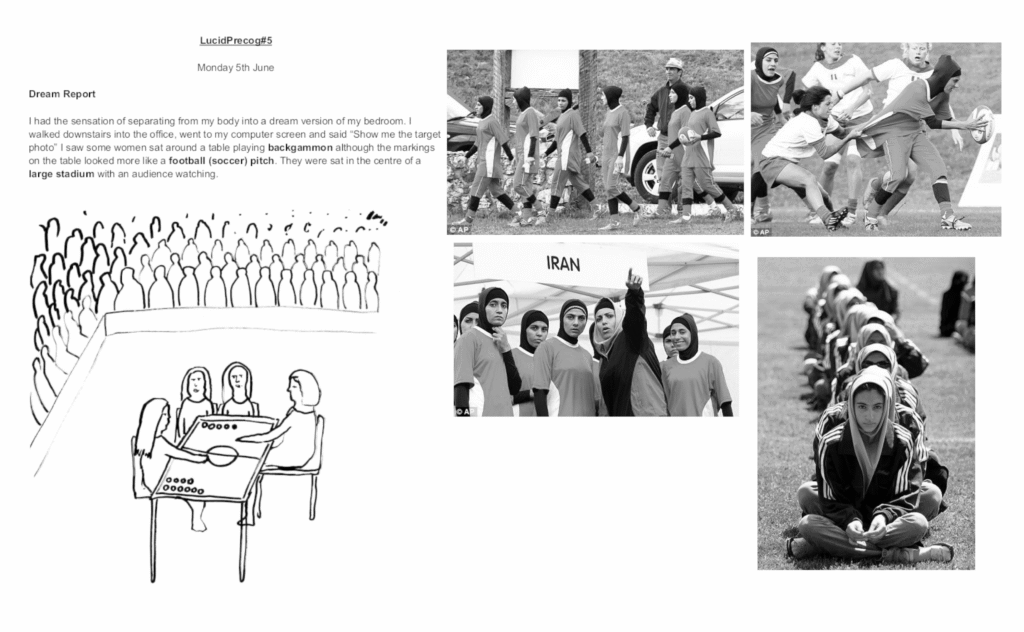
People have reported precognitive dreams since the beginning of recorded history. Sometimes literal, sometimes symbolic or a blend of the two, these dreams have suggested to many that the nature of time and consciousness seems much more complex than materialistic perspectives. Unfortunately, science has largely neglected precognitive dreaming since it often happened randomly and outside of any controlled conditions.
Recent research on lucid dreaming appears to show how lucid dreaming might change-the-game for some precognitive investigations. In a
research study by Julia Mossbridge, et.al., a consciously aware lucid dreamer (and artist) sought out information about a future, randomly selected image target location (yet to be selected) in two sets of five trials.
According to the lucid dreamer, Dave Green, he would become lucidly aware in the dream and find a computer. While looking at the computer screen, he would usually ask or expect for the yet-to-be-selected target image to appear on the screen. Once he felt that he had received an image, he would wake, sketch out the lucid dream image and share it with the researchers.
According to the research protocol, then an “open-minded skeptic” using a random number generator would obtain a number connected to a pool of 478 images (used by remote viewers for
training). The randomly selected image would then be compared to the lucid dreamer’s drawing by three sets of judges: a Highly Skilled Set of Judges, a set of unskilled judges, and finally, computer AI judges from different AI systems.
Below you can see one of the promising examples from the precognitive lucid dream research published in the
appendix.In another example, the lucid dreamer came up with the image of a home that connected thematically to the target location (i.e., a yurt like home in Kyrgyzstan), but also very closely matched the open-minded skeptic researcher’s home that he planned to put up for sale:
Reported Conclusions
The researchers conclude in part, “In these data we find weak but encouraging evidence for the possibility that our case study participant and co-author DG is a precognitive lucid dreamer. The skilled human judging process that was originally pre-registered did not allow independent judgments, so we cannot easily assess whether the three “hits” exceeded chance. Meanwhile, the best-performing AI models (L3, Ada and Nomic) each performed beyond chance (50% correct) for one of the material sets, but the AI analyses themselves were exploratory.”
The report finishes, “While current results present some evidence for dream pre-cognition within the context of lucid dreaming, we continue to caution that thoughtful approaches to both human and AI judging are necessary to fully understand the evidence for, and characteristics of, dream precognition using any protocol or paradigm.”
The judging of results poses considerable issues especially when imagery and symbols are involved. For example, a precognitive participant may grasp that a ‘home’ seems the informational theme, but may spin the imagery into their personal cultural or emotional perspective about a home. So too may the judges appreciate the thematic ‘hit’ but discount the dreamer’s drawing if it does not literally match a target on a structural level.
When it comes to this particular study, I wonder if the results would have been better if the target pool of images simply focused on one, easily understandable image? As I looked at some ‘target images’, I felt perplexed on how to describe it while consciously aware in the waking state because of the complexity of imagery or the multiple areas of focus.
This point reminded me of lucid dream colleague Ed Kellogg’s suggestion to the hosts of a 2004 psi contest:
“In choosing images, one could pretest potential psi target images for recognizability, and limit the selection of target images to those which an audience would correctly identify without pause or hesitation even if only flashed on a screen for a fraction of a second. (To properly simulate the conditions of dreaming perception as closely as possible, I’d recommend using a tachistoscope for image display, and a pretest audience made up of barely-able-to-walk drunks!)
Using complex and bewildering images, however aesthetically pleasing, may unnecessarily make the process of identification of a target image more difficult and error prone. Paying attention to how dreaming perception works, and using this information to optimize the design of an experiment, may well increase the probability of success for the participants, and in doing so increase the likelihood of obtaining statistically significant results.“
Dream Telepathy at the International Association for the Study of Dreams
For more than 30 years the International Association for the Study of Dreams (IASD) has conducted an annual Dream Telepathy Contest at its annual conference in recognition of the extraordinary research in dream telepathy conducted by Montague Ullman, M.D. and Stanley Krippner, Ph.D.
Unlike the
research conducted by Mossbridge, et.al., the telepathy contest has always involved a telepathic sender, who would see the target image and then attempt to broadcast the imagery telepathically to participants. For example, the telepathic sender might physically ‘act out’ the target image scene or mentally verbalize the imagery, all in the privacy of their room.
As you might expect, a dream telepathy participant would sometimes become lucidly aware on the night of the dream telepathy contest and then seek out the information or the telepathic sender! In my first book, Lucid Dreaming – Gateway to the Inner Self, I reported the case of a talented lucid dreamer, Clare Johnson, who became lucidly aware when she sees the telepathic sender (Beverly D’Urso). Clare reported:
“I see Beverly across the room and know that I am dreaming this. Beverly looks cheerful but I think she’s got to be tired since she must be having a sleepless night trying to transmit the image. I ask her how she is feeling. She flings her arms out, grinning, and says, “I’ve just been shouting the word inside my head!”
“That’s interesting,” I say, “because in my last dream, people were shouting about trees.” I want to ask her outright if tree is the [target] image she is projecting, but think this might be cheating. A woman across the room says excitedly, “I’ve been getting that, too. Tree shouting.”….Then, very slowly, I wake up. I am smiling in the dark. “The telepathy picture really might be a tree,” I think.” (p.180)
As it turns out, the target image from that telepathy contest was a photo of giant trees in Sherwood Forest (UK), similar to this one:
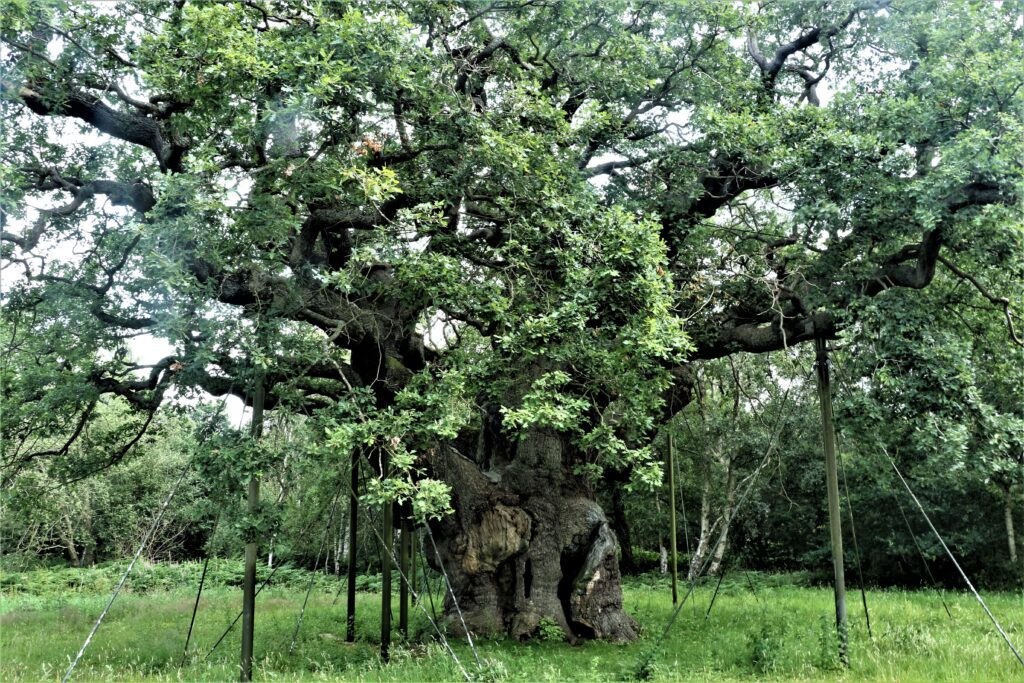
I bring up this example to express the difference between connecting with another person in a lucid dream, and the more abstract sense of connecting with a future image selection process (as in the Mossbridge study). As social creatures, our belief system and mindset may find it easier to ‘expect’ to access information that another has in the dream-state, which will be revealed later in physical reality. Also, this image of a tree in Sherwood Forest meets Ed Kellogg’s criteria of easily identifiable within fractions of a second, and relatively easier for judges to score.
Over time, I feel the issue of using lucid dreaming to access yet-to-be-selected precognitive target images will emerge as a fruitful area of study, especially as the potential target pool receives careful analysis and vetting by researchers and participants. Aware in the depth of dreaming offers new avenues to explore the nature of consciousness and its rarely considered abilities.
 Lucid Dreaming and Living Lucidly: Gateway to the Inner Self
October 22 – November 21, 2026
Join this 4-week online workshop with support and guidance provided by Robert Waggoner, Ed Kellogg, PhD, and Gillian Thetford.
LEARN MORE AND REGISTER
 Robert Waggoner wrote the acclaimed book, Lucid Dreaming – Gateway to the Inner Self (now in its sixteenth printing), and co-authored Lucid Dreaming Plain and Simple with Caroline McCready. His books have been translated into French, German, Chinese, Korean, Czech, Finnish and other languages.
A past President of the International Association for the Study of Dreams (IASD), Robert currently serves on the Executive Committee. For twenty years, he has been co-editor of the online magazine The Lucid Dreaming Experience the only ongoing publication devoted specifically to lucid dreaming. Recently, he helped found the non-profit Lucid Dreaming Foundation to spread the practice, research, and beneficial use of lucid dreaming.
Robert frequently speaks on the science and practice of lucid dreaming at international dream conferences, workshops, and college classrooms. He has been interviewed or consulted about the practice of lucid dreaming by CNN, CBS News, and ABC News (KABC – Los Angeles) along with Iowa Public Radio, WPNR, WBGU, and other radio stations. A lucid dreamer since 1975, he has logged more than 1,000 lucid dreams.