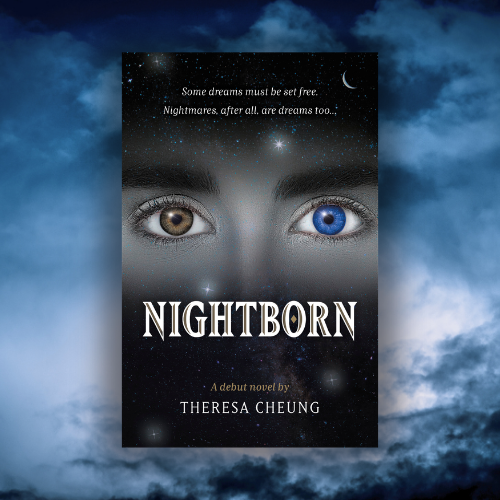
What if the line between your waking life and your darkest dreams disappeared forever? Alice Sinclair, a driven psychology professor, is about to find out.
Enjoy Chapter 1 from NightBorn, a debut novel written by Theresa Cheung.
Prologue
Florida, USA—Sometime soon
Alice saw the wave. It was a beast. It rose slowly at first, the way a predator prepares to strike—silent, inevitable. It quickly gained speed, swelling into a towering monster, a force of nature, as if the ocean itself had decided to swallow her whole. The wave surged, easily 30 feet high, dark and roaring with a ferocity she could feel in her bones. It moved toward her with the relentlessness of fate.
She turned, panic seizing her as she raced up the beach, her bare feet slipping in the wet sand. The ocean was closing in—the world was closing in on her. Her breath came in jagged gasps, but the wave, too quick, slammed into her, yanking her under. Her body twisted through the water, eyes stinging, lungs burning, desperate for air, clawing at the debris swirling around her—plastic, broken wood, seaweed, dead fish—but there was no solid ground to cling to. The current pulled her deeper, its grip tightening like cold fingers around her throat.
She gasped for air, choking on the water, the world a dark, crushing void. She couldn’t see. Every nerve in her body screamed for release, but the ocean kept pulling, tumbling her in every direction, turning her body like a puppet with broken strings. She was drowning. No—she was going to die. Something in her snapped.
Her feet hit something solid. Hard. Stone? She couldn’t tell. All she knew was that she had to rise. She shoved upward, throwing her weight toward the surface with every ounce of strength she had left. Her body screamed, but she pushed harder, until her head broke through to air. For one split second, she inhaled—but the water dragged her down again, relentless, hungry for her life. She fought the instinct to panic. She couldn’t let it win. Not today.
“Just breathe. Just breathe, Alice.” Instinctively she let herself float, stilling her body, letting the sea carry her, accepting the weight of the water around her. She couldn’t fight it anymore—but maybe she didn’t have to. Her feet found solid ground again. She shoved upward, defiant, gasping as she broke through. Sunlight blinded her.
Alice jerked awake, the sharp taste of salt lingering on her tongue, her body tangled in the sheets. The echo of the wave still thundered in her ears. The sunlight slanted through the bedroom window, blinding. Her pulse thrummed in her neck as if the sea still had its grip on her. “You’re okay. You’re okay. It was a dream. Just a nightmare.” What if it wasn’t just a nightmare?
Swinging her legs over the edge of the bed, Alice’s feet hit the cold floor. Had Swiss psychiatrist and dream analysis pioneer, Carl Jung ever felt this unsettled after one of his dreams? Had his own night visions ever made him question his grasp on reality? Her eyes flickered to the bedside table and her Red Book: the dream journal she’d named after Jung’s own. Ever since she was young, she’d written down her dreams. But this one felt radically different from the rest.
It was too real, though it clearly wasn’t literal. She lived more than an hour from the nearest beach and had never been to it. Was the dream a symbolic glimpse into her own future? A warning? Or something darker, deeper? It was just a dream. Maybe it was just all the energy she’d poured into teaching Jungian dream analysis spilling out cathartically in a nightmare. The feeling of drowning clung to her.
She grabbed her journal and scribbled out every detail of the dream. The ocean. The wave. The suffocating terror. Jung had called the act of recording dreams an act of self-analysis—so why did this one feel more like a clear and present danger than an analysis? Was it the forbidden mystery Jung had hinted at in his Red Book—that thin line between genius and insanity where revelation could be found? Was her obsession with dreams driving her mad?
It was her calling, her passion. Perhaps, as director of the new program in Jungian Studies at the University of Central Florida, she could teach her students what she had dreamt and encourage them to analyze it; maybe it would be cathartic for them and for her. What if her students were the key to unlocking the deeper meanings of her own dream?
She could see herself standing before the class, scrawling on the blackboard, her voice filled with energy as she taught them about using their dreams to peer into possible futures, even to shape reality. Inception—she would reference that for sure, the perfect movie fix to illustrate how the subconscious could manipulate perception and even reality. What better way to introduce her students to the power of their own dreaming minds?
Alice pushed herself out of bed as the sinking feeling of the dream still clung tight. Blinking rapidly in front of her bedroom mirror, she forced herself to take deep breaths. Her long dark hair framing the mismatched eyes staring right back at her: one blue, one brown. She had always hated this difference. Always hidden it behind a pair of blue lenses.
A perfect illusion of normalcy, her blue lenses. They always worked—ever since she was 14, when her mother had taken her to the ophthalmologist to prevent the cruel teasing at school. Alice slipped them on, as though the simple act could shield her from her nightmare. The rhythm of her repeated blinking to help the lenses settle helped bring a semblance of calm.
Something was coming, though; she could feel it. Something was drawing her, pulling her into the unknown. Could she rise above and survive it? Alice dressed the part for her day ahead and stepped out into the bright light of the day. Was the drowning nightmare a message? A warning? And if so, a warning about what?
Part One: Nightfall
“The persona is a complicated system of relations between the individual consciousness and society, fittingly enough a kind of mask, designed on the one hand to make a definite impression upon others, and, on the other, to conceal the true nature of the individual.”
—Carl Jung
Chapter 1
Alice’s modest apartment was just a 15-minute drive from the sprawling campus in east Orlando, a vast 1,400 acres of land. Much of the land remained untouched, with wooded areas permeated by numerous jogging and hiking trails. She found a vacant spot in the faculty parking area, slung her bag over her shoulder and headed toward the stunning three-story building that housed the psychology and philosophy departments. They shared the massive building—74,250 square feet—with the Learning Institute for Elders, LIFE, which served seniors in the community.
By the time she’d graduated from grad school ten years ago, she’d been offered positions at the University of Miami, the University of Florida in Gainesville and here at UCF. The only place she could imagine herself living and working was Orlando, the home to Disney’s “land of dreams,” so here she had been since her first year in 2022, when Covid was waning. Mostly virtual classes that year. By early 2023, though, the shift to in-person learning again was complete, and she’d settled into the rhythm and rigmarole of campus life forever after.
Inside the lobby, she made her way through the throngs of students changing classes. One of her colleagues, Amira Mensa, a philosophy and communication professor, fell into step beside her as she made her way to her lecture hall. The two had instantly connected when they joined the university teaching faculty on the same day, and in the years that followed, they grew ever closer, bonding over their love for inspiring their students and their shared passion for coffee shops, antique bookstores and The Lord of the Rings trilogy.
“Hey, Alice,” Amira called out. “You’re not going to believe this.”
Amira was a tall woman, about five ten to Alice’s five four, so Alice often found herself craning her neck to meet her gaze. Today, the sunlight streamed through the faculty’s great glass windows and danced on the brightly colored beads woven into Amira’s thick braided raven hair. Like Alice, she was in her late thirties, but her skin was tawny, not pale like Alice’s, and her celadon eyes shone so vividly that sometimes Alice could almost glimpse her own reflection in them.
“Odd campus gossip?” Alice replied.
Amira’s smile faltered. “It was stranger than that.” Leaning in, “you were in my dream last night. But not like you think.”
“What kind of dream are we talking about? Should I be flattered, or worried?” Alice tried a teasing British accent: “Was I the beacon of light guiding you through darkness? A savior when all hope had crumbled?”
Amira looked like the dream was still haunting her. “It started in my house—but not like any house I know. I found this room—hidden, buried behind a false wall. I didn’t even know it was there. When I stepped inside, it was empty at first—just cold walls and silence. But then… you appeared.” She paused. “It was you, but not all of you. Just your face, floating in the ether, like a creepy clown’s face balloon. It felt wrong. Your hair was the same, but shorter—just at your ears—and it looked like you, every detail, every contour. But your eyes…”
Amira had never seen Alice without her blue contacts. Amira shuddered. “One was dark, deep, like a void. The other was blue, bright, almost alive. There was something about them—something wild—like they weren’t even your eyes anymore. And they were watching, always watching me, so intensely… it was chilling.”
“An unfamiliar or secret or unused room is super—exciting news!” Alice blurted. She could never resist slipping into Jungian dream analysis mode. “Houses in dreams are typically a symbol of your sense of self.”
Since her dreamwork research had become more widely acclaimed, Alice had lost count of the number of times her colleagues and students shared their dream stories with her. She found it very moving; they didn’t realize it, but they were baring something intimate, something hidden. Alice treated every interaction as sacred. And she always offered a positive spin, something that would help them.
“You might just be on the verge of something big, Amira—personal transformation is on the horizon, or needs to be. Hidden creative depths, unexplored potential—how exciting! But… but the room was empty until I showed up and took over. What was I doing?” Alice’s voice dropped. “Was I drowning?”
“I don’t know,” Amira pondered. “You just appeared out of nowhere. And then the scene switched, and you were falling from the top of a cliff or something. You were disappearing into the darkness below. I stood at the edge, frozen, unsure—should I jump too, follow you down, or just watch as you vanished? I couldn’t move. I just watched you fall, helpless, as the distance between us grew.”
“Did I say anything as I fell?”
“Nothing.”
“Interesting. Falling is the most common dream that people report—around the globe,” Alice offered. “If I were your dream therapist—which, thank goodness, I am not, because the best person to interpret their dreams is always the dreamer herself, as dream symbols have personal as well as universal meanings—but if I were helping, I’d say the theme here is feeling unsupported. Or maybe even out of control.” She didn’t notice Amira wince. “The big question, though, is: Is this dream about you or about me? I’m still working on how to interpret the meaning of other people moonlighting in our dreams.”
“Pray tell.”
“Well, Jung believed that if the person in the dream is a family member or partner, it reflects your relationship with them. But if it is not an intimate relationship, they symbolize something about you—an aspect of your mindset or personality that you need to understand or integrate. Which means that when someone cameos in your dream it is like every other symbol in your dream: all about you. Think of a dream as stepping into a hall of mirrors revealing your unconscious mindset or beliefs. Dreams don’t happen to you. They are created for you, by you, and they’re all about you. That is their real magic. So, lecture over—which is it? When you think of me, what is the first word that comes to mind? Don’t overthink it. Just look at me and go with what comes to mind.”
“Perhaps this dream is about both of us heading for a fall? Aren’t you always saying how much dreams love to pun? As for what springs to mind when I think of you, do you want brutal honesty, or should I go with what you might want to hear?”
“Honesty, of course,” Alice declared. “Dreams don’t lie, and neither should friends. What is the word? I promise I won’t take offence.”
Amira hesitated. “Incomplete.”
The word caught Alice off guard. She loved it, though—dreams, like real friends, never hid the truth or offered up the predictable. No room for growth in what you already knew. “Reflection—that’s what dreams want us to do,” she told Amira as they split off toward their respective classrooms. “Yours is already casting a spell on me. Let me know if you remember anything else about it, okay?”
She was like a dream vampire: never satisfied. Of the 22 students in Alice’s class—an ideal, not overwhelming number—only one had arrived so far. Neal King, a slender, brilliant kid with aspirations to be an artist, was sitting quietly at the back.
“Hey, Neal.”
“Professor Sinclair.” Neal shot to his feet, scooping up the project he’d been hunched over. “Got something I think you’ll want to see.” He could barely contain his excitement as he lay a charcoal sketch on Alice’s desk. It was a version of Alice—with shorter multicolored hair, a rounder chin, and eyes that mirrored her own blue lenses.
“This was you in my dream last night, Professor Sinclair. Only, one eye was blue, the other was brown. But I was out of brown chalk, so…”
Holy shit. Alice blinked. Slowly. “What was I doing?”
“We were discussing Jung—specifically, his first meeting with Freud, the whole telekinetic or mind-reading thing that happened when Jung asked Freud what he thought about the paranormal. I think we were talking about the movie version, but then for no reason you started throwing books at me and it freaked me out so much I woke up.”
The Dangerous Method was one of Alice’s films to reference to her students. “Viggo Mortenson as Freud and Michael Fassbender as Jung. Fascinating movie and dream referral to it, Neal. Shame about the book throwing, but perhaps that’s just me telling you that my academic expectations of you are high.”
Neal beamed. Other students began trickling in, chatting and settling into their seats. Alice eyed the sketch. “Mind if I keep a copy of this?”
“Sure. But there’s more,” Neal said. “A couple of people in my comparative psyche class also dreamed about you—except for them it was more of a nightmare than a dream. Noah dreamt you buried him alive. Maybe he’s struggling with his dissertation, feeling stuck? Eve told me you shot her with a pistol. Maybe she’s feeling like forces outside her control are out to get her? Or she is just scared you might mark her down.”
“Spoken like a budding Jungian dream analyst. But nightmares are still dreams, just extreme ones. Usually, the dreaming mind tries sending gentle messages first in dreams, but when we ignore them, things typically escalate into shock tactics. Nightmares can be tough to forget, which is exactly what your unconscious mind is always after: your undivided attention. When we dive into our shadow work seminars, you’ll learn more about how nightmares expose what’s repressed inside us, screaming for recognition—but which we refuse to face and understand in our waking time. So please,” she glanced around at the small crowd gathering for class, “don’t hate or be scared of your nightmares. Understand and communicate with them and have compassion for them, instead. Recognize them for what they are: transformative gifts to help you become wiser. They hold the key to your self-awareness and your personal growth.”
Neal looked surprised.
“They are a warning light flashing at you from the inside out to show you that something about your current mindset isn’t serving your best interests,” she urged. “But that doesn’t mean it is game over. You can change your perspective in a flash, steer a new course for yourself, if you want to stop waking up to a terrifying dream.”
Salvador Dali had described his art as “photographs of his dreams.” As Alice spoke, she could practically see the gears turning and imprinting themselves in Neal’s head. “I’m not sure if I should be flattered or freaked out by all these dreams starring me. It’s next-level stuff, even for me. Did any of your friends mention the different-colored eyes as well?”
“They definitely did.”
So, four people had dreamed about her last night. And Neal King’s charcoal sketch bore an uncanny resemblance to her. But none of them had ever seen her without her contacts. What was any of it supposed to mean?
Class that day was a great session: a good vibe crackling. After, at the door, Neal handed her his sketch. “I did it on my iPhone too, in color, if you’d like me to send you that?”
“Wow,” Alice said as the image appeared on her phone. It was her—eerily so. Even the eyes. “Strange, huh?” Neal replied. “What do you think it means, Professor Sinclair?”
“No idea. For now, I’m chalking it up to a bizarre coincidence. In dreamland, would we expect anything less than the unexpected?”
According to Jung, coincidences were signposts, meaningful connections or synchronicities; they never happened without reason.
“Could it be something tapping into an archetype?” Neal questioned. “Something from the collective unconscious? People, things, feelings, the life stages we all share—just like you talked about today?”
“Guess we’ll have to wait and see. But thank you again for the sketch. It’s not every day you become the star in someone else’s dream.”
The employee dining room was always bathed in sunlight—owing to the row of tall windows. As usual, Alice and Amira had snagged one of the tables beside the copious amounts of glass so that they could watch the courtyard below. A fountain bubbled at its center, surrounded by a plethora of greenery and flowers that drew every bird in the neighborhood. Today, someone had hung a couple of hummingbird feeders from the branches, and now a pair of these little beauties fluttered at the feeders, their tiny wings flapping ferociously in a near-invisible blur. Alice stared at the birds, sensing some message meant for her. Certain esoteric traditions and dream symbology treated birds as conduits between worlds: messengers, but only for the person who saw them.
Alice had never lost anyone she cared deeply about, so this wasn’t a message igniting a fond memory of a departed loved one. Maybe it was an omen, a promise she’d soon make sense of this bizarre dream phenomenon. The vibrant flowers before her were symbols of comfort and beauty, even hope. All Alice had to do was keep calm, rise above, and wait to see the bigger picture.
Amira looked to the hummingbirds fluttering at a feeder. “Wow, positive sign, those little guys,” she slid into the chair across from Alice, setting her briefcase down and giving Alice a once-over. “You look like you’ve just discovered a major secret.”
“Let’s get some food first,” Alice pleaded, “I’m starving.”
Alice helped herself to a tuna casserole with mushrooms and cheese, a slice of warm, buttered French bread, and a glass of honey-flavored iced tea. The university cafeteria food was surprisingly good. Once they sat down again and settled in, Alice brought out her phone and showed Amira Neal’s digital sketch. She passed it to Amira, who studied it so intensely that Alice had to consciously blink to keep her nerves in check.
“Wow, that really does look like you. Except for the different-colored eyes.”
Making sure no one was watching; Alice took out her contact case and removed her contacts. When she looked up, Amira drew in a sharp breath. “Christ. It really is you.”
Quickly Alice popped the lenses back in. “Keep that to yourself, okay? My odd eyes have freaked people out my whole life. I’m only showing you because something strange is happening, and I need to find out what the hell is going on.”
For several unraveling moments, neither of them spoke.
“This has ‘Jung’ written all over it,” Amira finally broke the silence, “and not just because he’s your absolute specialty. It reminds me of that story about his patient and the scarab. Total synchronicity—like life itself is pulling the strings.”
In the fabled story, Jung was treating a woman who had recently dreamt of a golden scarab, an archetypal or universal symbol of death and transformation. At the exact moment she was telling him, a beetle tapped on Jung’s window. He caught it and presented it to her. The incident had shattered her skepticism and opened her mind to therapy. In a way, it had launched Jung’s deep dive into synchronicity, even precognition.
Could the bizarre incident of people dreaming about her be the puzzle piece she’d been missing for her next big project? Alice had had an independent publisher hounding her for a book proposal ever since her TED talk on synchronicity, but she hadn’t been sure of the direction she should take. Now her entire body hummed with the spark of possibility.
“You may be right,” she told Amira, “but I need to dig deeper. You and Neal, and the other students, all know me. I’d be rattled if someone I’ve never met claims to have dreamed about me.”
“Four people in one night is out there enough for me. It must mean something, don’t you think?”
Alice’s appetite left her. It felt as if the universe had just dropped a cryptic treasure map right in her lap—and the next step was all up to her. And what frightened her the most was not so much that she didn’t have a clue about the how or why, but what she was dealing with.
By the time Alice left campus at around 4:30 that afternoon, no one else had approached her to tell her they had dreamt of her. Maybe it really was just a random fluke, one of those oddball blips in the scheme of things. She felt relief and a hint of disappointment in her reaction. Jung would have seen that “blip” as a cosmic sign, a synchronicity, and run with it.
Why couldn’t she?
…Continue reading on to Chapter 2 in NightBorn by Theresa Cheung.
