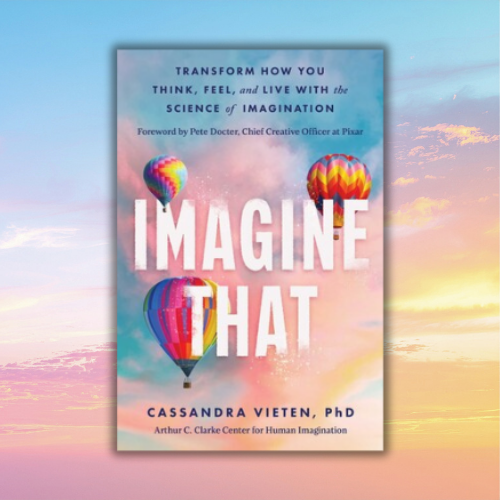
What if the most overlooked key to improved mental health, innovation, and human connection was your own imagination?
Drawing on her groundbreaking scientific research, Former IONS President Cassandra Vieten takes readers inside the living, dynamic brain of imagination, revealing how it works, and how it can be intentionally harnessed to reshape the way we think, feel, and live. She introduces the concept of imagination neurodiversity: the game-changing insight that each of us possesses a distinct pattern of imaginative strengths, tendencies, and untapped capacities that can be understood, cultivated, and activated.
Enjoy this excerpt from Imagine That, written by IONS Senior Fellow Cassandra Vieten.
Introduction
Imagination is a kind of magic. Through imagination, you can not only escape the limitations of the physical world, but also transcend them. You can enter into states of mind that are not bound by the conventional rules of physics and space/time, or the restrictions of your physical body. You can fly, you can time-travel, you can breathe underwater, you can dance with dragons. You can visit faraway friends or those who have passed away. You can experience the impossible. Nothing is off-limits when you harness the power of your imagination.
Imaginative speculation allows you to be released from your pre-existing categories, assumptions, rules. To not only think outside the box, but toss the box away completely. In your imagination, you can travel through territories of possibility, through landscapes of wonder, to alternate worlds. You have within you the ultimate metaverse—a vast array of worlds with infinite potential waiting to be explored. As with any adventure, when exploring the inner worlds, it helps to have skills, tools, and a map. This book is that map.
A Crisis of Imagination
In my role as a psychologist and scientist who travels the world talking to folks about imagination, mindfulness, and integrative health, I can tell you that across ages, professions, and walks of life, there is a growing epidemic of people feeling stuck, burned out, exhausted—and disempowered to do anything about it.
The technology that was meant to ease our lives has accelerated them so dramatically that many people feel like they must plug in at daybreak and unplug at bedtime, just to stay current. We are all feeling more disconnected than ever despite being “connected” to everyone. People tell me they feel flooded—by information, by news, and increasingly by an ongoing sense of threat, reinforced by the steady stream of upheavals at home and around the world. They are asked to seek, receive, synthesize, and manage information, but rarely do they get to create new ideas or experiment with possibilities. Their inspiration is deflated, and their motivation dampened.
We humans have always been explorers, adventurers, driven and defined by what we don’t know. But in modern society, we seek too quickly to land on an answer. We don’t spend enough time in liminal space, in possibility land. Our search engines and artificial intelligence are incredible time-savers, but they can deprive us of the time we used to spend wondering, mind-wandering, and conjecturing. Too often, spending time in not-knowing is now seen as a waste of time.
Many people are trapped right now not by external barriers, but by the boundaries of what they can imagine. It’s not willpower or intelligence they lack, but the ability to mentally construct alternative futures. They can’t see the job that would fulfill them, the relationship dynamic that would work, the solution to their recurring problem, or the version of themselves they could become. Their imagination has been constrained by experience, fear, or simply lack of training.
And it’s not just us as individuals. As a society, so many of the issues facing us locally and globally are rooted in our collective inability to imagine new solutions, alternative futures, creative pathways forward that could build a world that promotes thriving for all.
The Great Flattening
Vast numbers of people are experiencing what my friend and colleague Dr. Lisa Miller at Columbia University calls “diseases of despair”: anxiety, depression, addiction, loneliness, even suicidality. These result from, on the one hand, an extreme narrowing of imagination—black-and-white thinking that incorrectly leaves us believing there are only two possibilities, and in the worst cases, only one. In fact, the origin of the word despair is “no hope” (de = “no,” or “lack of,” and sperare = “to hope”). Paradoxically, despair is also being driven by an overabundance of negative imagination, or habitually imagining a wide range of the worst possible things (I’m worthless, people hate me, something terrible is going to happen).
To this profound characterization of the crisis of the human spirit we’re witnessing, I’m adding the phrase “diseases of disenchantment.” I mean this in two ways. Not only is imagination becoming atrophied, just like a muscle wastes away due to underuse, but we are misusing our imagination. When this happens, life begins to feel repetitive, dull, or devoid of meaning—mind-numbingly routine, lacking in heart, soul, and vision.
The modern meaning of disenchantment is to be disappointed, disillusioned, or no longer believe in the value or integrity of something. But the word was made philosophically significant by Max Weber, using the German word Entzauberung, which literally means “demagicization,” or getting rid of the magic. Weber thought the disenchantment of society was the birth of reason, science, technology, and social order (or bureaucracy), but also a sense of meaninglessness and alienation—what he termed the “iron cage” of rationality. You’ve probably heard the phrase “the magic is gone” to talk about everything from sports teams losing their mojo to the dwindling of romance in a relationship.
The Hidden Solution
Here’s the good news: A building resurgence in both science and humanities is converging on the idea that you have within you a system to counter the epidemic of despair and disenchantment we’re experiencing. It won’t change the state of the world—at least, not at first—but can transform your reactions to it. This is something we all possess, something we all can practice, for free and with equal opportunity. It is the seed of every breakthrough, new solution, social movement, and invention, as well as every dream. It is, of course, imagination.
When someone develops this capacity, they gain something almost magical: the ability to see multiple futures simultaneously and navigate toward preferred ones. They’ve stopped feeling stuck because they can mentally construct pathways forward. They’re more resilient because they can imagine how current difficulties lead to future growth. They make better decisions by vividly simulating outcomes. They live with awe, humility, curiosity, and engagement with the “what-ifs” that make life fascinating.
This is perhaps the ultimate human freedom: not being limited by what has been, but empowered by what could be. While others remain trapped by the constraits of their current reality, people who have fostered the skill of imagination live in an expanded universe of possibilities. It’s the difference between being a prisoner of circumstances and an architect of futures.
You, too, have the ability to transcend your current circumstances and limitations. Not by wishful thinking, but by literally expanding what you can mentally perceive as possible. Being able to envision new possibilities, alternatives, and original solutions, to navigate the realm of uncertainty and potential that lives within us all, to inspire yourself and others: These are all capacities that must be cultivated. This isn’t about positive thinking or creativity exercises, it’s about understanding and employing a sophisticated cognitive system that can be developed, just like memory or reasoning.
Imagination isn’t frivolous daydreaming, it’s a working tool of the brain, integral to adaptive behavior and enabling learning, foresight, empathy, and problem-solving. Cognitive scientists now consider it a core component of intelligence itself. We use imagination daily, often without realizing it: recalling the past, planning tomorrow, empathizing with friends, solving problems. It shapes our brains and destinies. Like with other areas of cognition, repeated practice strengthens and rewires neural connections. And a multitude of studies now show that what we imagine directly influences what we do.
A growing science of imagination is emerging, much of it from just the last decade, making a revolutionary promise: You can expand your mental capacity to generate and explore possibilities currently invisible to you. What we are learning about imagination can help you learn to harness what turns out to be one of the most important parts of being human.
My Journey to Imagination
I once spoke at a retreat center with a fellow presenter who was a senior researcher reaching the end of his career. He was a quantum physicist who was also interested in spirituality, but he was beginning to experience some cognitive decline. Speaking more slowly and methodically than usual, with long pauses between sentences, he said something quite simple a few times during his talk—simple yet profound.
It was this: “Everything has an exterior, and an interior. We have an outer world, and an inner world. There is a material world, and an immaterial world.”
It was such a simple statement, but one that rang a resounding bell of truth within me.
There is the physical world, in which the form things will take has been decided, and a world of potentiality, in which the shape things will take has yet to be determined. And both are real. Both are important. My career has been dedicated to the investigation of this vast inner landscape.
When I was a kid, I was completely fascinated by the natural world. My parents had a nearly full set of National Geographic magazines in the built-in bookshelves in the shag-carpeted sunken den of our house. Between those iconic covers with the yellow borders lay seemingly infinite other worlds—fluorescent worlds deep below the surface of the sea, behavior studies of big cats on the savannah, cultures with a dizzying array of body modification practices, the stunning art and imaginal world of Australia’s aboriginal people, the snowy existence of polar bears. These images and descriptions, and the idea that that they were very much real and actually existed somewhere on the planet, stretched my zone of possibility to the point that it seemed almost anything could exist.
My dad was a biochemist and would bring me to his lab at the university, where I ran down the hallways with him in a too-big lab coat, sleeves dragging along the linoleum halls. He would boost me up on a stool by his lab bench to look at cells, or microbes from the pond water we brought with us from the park. It was awe-inspiring to me that not only the larger world, but the tiniest microscopic world held wild mysteries and undiscovered frontiers ripe for exploration.
My mom was a Jungian-inspired counselor, interested in dreams, myths, symbols, women’s spirituality, and learning from the world’s religions and shamanic traditions, who introduced me to an inner world that could be explored. A world of a different kind of truth, perhaps not measurable but profoundly influential nonetheless.
For me, the library was a wonderland. Fiction held the key to better understanding the outer world and plumbing the depths of the innerworld, both worlds full of stories, emotions, faraway lands, new possibilities, and impossibilities. Books like The Chronicles of Narnia and The Lord of the Rings became deeply meaningful to me.
When my parents divorced, it was a difficult time (don’t worry, they later both found perfect matches and I ended up with four wonderful parents). At that time, though, I felt alone, with feelings and thoughts too big to handle or even describe. When I heard about another family’s divorced parents, I could feel some relief at not being alone. But it was a less literal, more fantastical story that truly made me feel seen and helped me understand my family in new ways. When I read in A Wrinkle in Time about Meg’s father being encased in a pillar where no one could reach him, there was a truth in that story that came much closer to what I felt like in the days between the weekends I spent with my dad. Then, when the weekend came and Dad and I were together, our discussions about the book’s story of traveling between universes by jumping across a space-time wrinkle, along with watching shows like The Twilight Zone, Carl Sagan’s Cosmos, and Leonard Nemoy’s In Search Of together, helped me gain a larger perspective on life, and on my situation. And times in the library or bookstore with Mom during the week helped us both find and tell stories that built bridges for healing.
As I approached adolescence, though, I began to feel overwhelmed by even bigger emotions. I wasn’t sure if anyone else was, honestly. Existential concerns: Why do we die? Why is there cruelty? Personal struggles: Why can’t I be cool? How do I feel less anxious? Undifferentiated but overpowering feelings of sadness, fear, love, loss, outrage at the injustices in the world, and also fearlessness, wanting to find the edges, live loudly and authentically. Again, the place I found stories, emotions, thoughts, and concerns as big as mine was in books, and then movies. The Stars both Trek and Wars, of course, and Close Encounters of the Third Kind, E.T., books by Stephen King and Douglas Adams and so many more. These all helped my heart know that, yes, other people feel these longings, the confusion, the outrage at injustice, the paradoxes of beauty alongside suffering; they also see the absurdities of life, and they express them through these stories.
As I grew older and made it through the toughest teenage years, I found personal relief in meditation and mindfulness, and my scholarly interests in college and graduate school turned to how we could better understand and navigate our inner worlds, both real and imagined, and how we could shift our world views and story lines for our health and well-being, and that of our society and the planet.
I could see my inner stories, speculations, and conjectures, but not be completely fused with them, could observe my own story line and see that it was not always true. I began to experience for myself how powerful changing my inner stories and images of reality could be. I was lucky to attend a graduate school that not only taught traditional Western psychology, but also Eastern philosophy and theories of mind, and indigenous perspectives. It was literally a PhD in our inner worlds, and how our stories about reality shape our perceptions and well-being.
So, you can probably see how, coming from a diverse background as a psychologist, mind-body medicine researcher, and scientist—as someone who gets absolutely geeked out about the intersection of brains, bytes, and big ideas—I was thrilled to find and later become the director of research at the Arthur C. Clarke Center for Human Imagination at the University of California, San Diego, where we study the neuroscience and practical applications of imagination. In parallel, at UCSD, I became cofounder and psychology director of the Center for Psychedelic Research, where I even get to explore the intense imaginings produced by psychedelics (as administered in clinical laboratory settings). And, in my role directing of the UCSD Center for Mindfulness, I lead a team creating and studying the effects of programs that help people learn to observe what they are imagining, and how it influences their states of mind, body, and behavior. I wear a few hats, but what ties this trifecta of imagination, mindfulness, and psychedelics together for me is this: Our inner world, and the stories and images therein, are powerful determinants of our health and well-being, our perceptions and behaviors, and our ability to inspire collective action.
One of the reactions I get sometimes when I tell people what I study is that it sounds frankly unscientific. How can something as ephemeral—and even frivolous—as imagination be a scientific subject? Shouldn’t real science be dedicated to curing diseases, making new biochemical discoveries, addressing the climate crisis, advancing the human condition?
I have trouble thinking of anything that could be more important in today’s world than finding out how we come up with original ideas, creative solutions, and new paths toward health, sustainability, and empathy. How we capture people’s imaginations and motivate them toward new visions of the future. In this scientific field, we work to improve the human condition by finding out how we come up with ideas for treatments and cures, make discoveries, and solve the most significant crises facing our society.
The Science of Imagination
A growing body of research is revealing how what you imagine profoundly influences your mental and emotional well-being. We are discovering what brain processes are involved in things like mental imagery, speculation and conjectures, creative leaps, and brilliant moments of insight, and how these in turn influence your brain, body, nervous system, hormones, and neurotransmitters. And we are learning how what you envision for your future can hold the key to bringing greater meaning, awe, wonder, boldness, peace, beauty, and richness into your life.
What if we could crack the code of human imagination itself? Not just philosophize about it over coffee (though we do plenty of that, too), but actually measure it, map it, and amplify it. That’s exactly what we do at the Clarke Center. Inspired by Arthur C. Clarke’s legacy of envisioning futures that seemed impossible until they weren’t, we’re working to make imagination more visible and actionable. If you’re curious about how imagination shapes everything from neural circuits to cultural futures, we’d love to have you join the conversation. We’re still figuring a lot of this out, and that’s part of what makes it exciting.
Advances in tools of neuroscience, virtual and augmented reality, artificial intelligence, and machine learning in just the last decade are allowing us an unprecedented ability to unpack the neurological, cognitive, and social components of imagination, and discover how you can cultivate and apply it in your daily life. We’ve also launched the World Imagination Network (WIN), a collective of scientists, scholars, philosophers, educators, and artists who study and apply imagination to inspire innovation and solve real-world problems.
We at the Clarke Center, along with our colleagues at WIN, believe in the power of imagination to enhance humanity’s essential nature and generate new knowledge and solutions. Imagination stands as a form of protest against the perceived confines of reality, a powerful tool for emancipation, and a catalyst for agency and possibility. We look to imagination to enrich and uplift human experience, to navigate the existential challenges facing the world today, and to chart a course for a better future for all.
The Promise
Here’s what we’re discovering: You have this amazing latent skill, this often unexplored territory, inside of you that is waiting to spring forth, to be rekindled and matured. This is your imagination. And it can help you move beyond your current confines and author a new story for yourself—and, together, for all of us.
We each have an imagination profile with unique strengths and challenges. In this book, you’ll use the models emerging from new scientific understandings about the neurodiversity of imagination (how people’s brains are wired differently to yield highly varied imagination capacities and experiences) to assess the multiple dimensions of your own imagination, find out how to leverage your strengths, and discover how to cultivate and expand your capacities for imagining.
And it goes far beyond just you as an individual. As a society, so many of the issues that face us locally and globally are rooted in our collective inability to imagine new solutions, alternative futures, or creative pathways forward that could build a world that promotes the thriving of all people and the planet. In an increasingly AI-dominated world, human imagination becomes more valuable, not less. Our unique ability to speculate wildly and forge completely new pathways—rather than being limited by formulas, categories, and algorithms—may become our most important differentiator.
My primary goal is helping people re-enchant their lives—to re-enliven their world, spark new hope, and reveal new possibilities through the science and practice of imagination. To help you escape the confines of your current “reality tunnel” and envision hopeful futures while experiencing more awe, wonder, and the ability to chart a new course for yourself and society. The antidote to despair isn’t just hope, it’s the skill to generate hope. The antidote to disenchantment isn’t just wonder, it’s the ability to re-enchant your world through purposeful imagination.
Imagination is what has always created a better way forward. This book is designed to help you understand its importance in everyday life and strengthen its breadth, depth, and healing potential. Consider this your user’s guide to accessing and using your imaginative function to influence almost every aspect of your life.
Imagination is not just for kids. It’s not just for artists, writers, or inventors. It’s not reserved for those with privilege and leisure time. Imagination is for YOU. Because you are human. You may have been told, or have come to believe, that you aren’t very imaginative or original. But I know that means that your imagination muscles have just weakened from under-use, and they can be strengthened again with practice and intention. It might also mean that you haven’t gotten to learn about your unique imagination profile, and how your particular underused imaginative talents and strengths can become your superpower.
Or maybe you’re very aware of your imagination, and find it overwhelming. You might be prone to maladaptive imagining—conjuring worst-case scenarios, or daydreams so alluring they sap you of the power to change your real life. Or, perhaps you know that imagination holds the key to finding new pathways for yourself and our society, and you want to optimize your imagination. You want to use imagination to rewire your brain, to use imagination hacks to accelerate and expand your ability to see alternate possibilities and futures, and know how to better speak the language of imagination in your change making efforts and persuasion. This book is for all of you.
In the first part of the book, you’ll learn what imagination is and how it works: our current scientific and philosophical understanding and how we got there, the many domains and subtypes, and how to understand your individual imagination profile. You’ll learn strategies for building your imaginative muscles and for making space for imagination to spontaneously fill your life.
Next, we’ll explore how imagination fits into our lives and how we can use it to shape them: how it changes our bodies, how it affects mental health, how you can use imagination to tell new stories about your past, present, and future, and how it manifests in daily life and relationships.
Finally, we will visit the realm of the numinous, the mysterious, the magical—where imagination extends beyond the rational, connecting us to deeper truths and layers of ourselves. I’ll tell you about active imagination and sacred imagination, which can be accessed through many modalities, including guided visualization, psychedelics, and shamanism.
When you finish reading this book, I hope you will:
-
Have a better understanding of your imagination and how it works. In order for you to get to the work of exploring your imagination, training it, developing it, and applying it, you need to know a little bit more about it. How is it structured? What does it do? Where does it live in the brain? You’ve got to get familiar with the territory in order to better navigate it.
-
Practice imagining. When was the last time you actively practiced imagination? When did you last make the effort to pop “through the looking glass” to visit the realm of imagination and spend some time there? What are the practices and tools you use to imagine? How do you intentionally imagine? In this book, I’ll give you the tools to spend more time consciously and actively visualizing, storytelling, conjecturing, wondering, and speculating, on purpose, and bringing what you learn back to transform your life and our world.
-
Create conditions conducive to spontaneous imagination. When you examine your life, when are you most likely to have a breakthrough? An aha moment? A creative download? These conditions might be external, like the people you surround yourself with, the environments you place yourself in, or the activities you engage in. And they can be internal, the states of mind, ways of being, attitudes you cultivate. It turns out, while purposely imagining is important, it is just as crucial that you create the surroundings that allow you to be in your “zone of genius,” welcoming those unbidden brilliant flashes of insight to come through you and into the world.
Consider this your user’s guide to accessing and using imagination to influence almost every aspect of your life. First, you’ll understand what it is and how it works. Next, you’ll learn imagination’s language, discover what kind of imaginer you are, and get tools for navigating your imagination’s territory. Then you’ll learn to apply it for creating an extraordinary life for yourself and our world.
Imagination is not a way out, but it is the way through. Let’s go!
…Continue reading in Imagine That by Cassandra Vieten.

Cassandra Vieten, PhD is Clinical Professor and Director of the Center for Mindfulness at the Centers for Integrative Health in the Department of Family Medicine at UC San Diego. She is also Director of Research at the Arthur C. Clarke Center for Human Imagination and Clinical Psychology Director at the Psychedelics and Health Research Initiative at UCSD. She is Senior Advisor of the John W. Brick Mental Health Foundation where she served as Executive Director from 2019-2023, and a Senior Fellow at the Institute of Noetic Sciences, where she served as President from 2013-2019. Her research has focused on spirituality and health, transformative experiences and practices, the development of mindfulness-based interventions for emotional well-being, and development of media technologies to inspire awe. She is author of the forthcoming book Imagine That: Transform How You Think, Feel, and Live with the Science of Imagination (Simon and Schuster, August 2026).
