
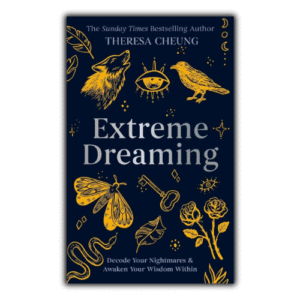
Extreme Dreaming explores the reasons behind bad dreams, and how and why nightmare themes shift at different stages of our lives as well as in reaction to global events. Along the way, Theresa decodes dream symbolism and lists the most common nightmares to never ignore. She offers advice on how to reduce the risk of nightmares, as well as simple techniques that will empower you to tune into the transformative power of your dark side.
This is more than just a book – it’s a toolkit to understand and harness the power of disturbing dream experiences. With Theresa as your guide, you will be able to heal your waking anxiety, integrate your shadow self and take a giant leap forward in personal healing and growth.
Enjoy this excerpt from Extreme Dreaming, written by Theresa Cheung, the Queen of Dreams.
How to Reduce Nightmares Without Running Away From Them
There is a question I am asked repeatedly as a dream expert: How can I stop having nightmares?
It is an understandable question. Nobody enjoys waking in the middle of the night with their heart racing after being chased, trapped, falling, attacked or confronted by something they cannot explain. A nightmare can leave you shaken long after you are awake.
But I have a slightly different answer. Rather than asking only how we can stop nightmares, I think it is worth asking what they might be trying to show us. Because sometimes the dream we most want to get rid of is the dream we most need to face and understand.
That doesn’t mean we should suffer unnecessarily. There are sensible things we can do to reduce the risk of disturbing dreams, particularly by creating a calmer transition into sleep and dealing with sources of stress during waking life. If nightmares are frequent, traumatic or seriously disrupting sleep, professional help is also important. But I don’t believe we should automatically regard nightmares as the enemy. Your sleeping mind may be trying to get your attention.
Think about what happens during the day. We become experts at carrying on. We put difficult conversations off, suppress worries because we have work to do, tell ourselves we are fine when we aren’t, and distract ourselves from grief, anxiety, anger or uncertainty.
Then night arrives.
The rational, busy and highly controlled part of the mind becomes quieter, and another aspect of consciousness begins to speak in its own surreal and highly symbolic language. A problem you have been avoiding might become a locked door. Feeling overwhelmed might become a tidal wave. A relationship in which you feel powerless might become a dream about being trapped. Something you desperately want to say but cannot express might become a dream in which you have lost your voice.
This is why I often say that nightmares can be emotional truth dressed up as theatre. They aren’t necessarily predicting the future. They aren’t evidence that something terrible is going to happen, and they certainly don’t mean that you secretly want whatever frightening thing you dreamed about. But they may be highlighting something you haven’t fully confronted while awake and revealing how that block is influencing your mindset and what that perspective is attracting into your life, and that nocturnal revelation can be valuable.
Noetic Dreaming
This is also where dreaming becomes particularly interesting from a noetic perspective.
At the Institute of Noetic Sciences, director of research Dr. Helané Wahbeh has been investigating the different ways people experience what IONS calls their Noetic Signature – their individual way of accessing and expressing information that appears to extend beyond ordinary sensory perception. Their research identified “knowing through dreams” as one of the distinct dimensions of noetic experience. In other words, for some people, dreams appear to be an important pathway through which insight or information is experienced. And nightmares are simply extreme dreams.
Dr Wahbeh’s channelling research also describes dreams as among the most common ways people report accessing noetic information, including experiences that people interpret as intuitive, precognitive or psychic.
I find this fascinating because it suggests that our dreams may be doing more than simply replaying the events of the day. Perhaps dreaming is one of the ways consciousness loosens its ordinary boundaries. Perhaps it allows us to encounter aspects of ourselves and possibly information that we don’t normally access through our five senses. And perhaps this is another reason not to dismiss a frightening dream simply as a bad dream.
The answer to reducing the risk of nightmares is not to become afraid of dreaming. It is to create better conditions for dreaming and, importantly, to become more comfortable with whatever arises. Here are some practical suggestions to help you do just that.
1. Give your mind somewhere peaceful to land
What you take into sleep matters. If you go to bed scrolling through distressing news, arguing with someone, working until the last possible moment or mentally rehearsing everything that could go wrong tomorrow, you are not giving your nervous system much opportunity to settle.
Create a small transition between waking and sleeping. Turn down the stimulation, take a warm bath or shower, read something calming, listen to music, or practise a few minutes of slow breathing or meditation.
You don’t need an elaborate bedtime ritual. The message to your mind is simply that the day is over and you are safe enough to let go.
2. Don’t go to war with a nightmare
If you wake from a nightmare, the instinct can be to push it away immediately. Turn on the television, check your phone and tell yourself it was meaningless. Sometimes that is exactly what you need. But if you are able, pause before you dismiss it and try to move on. Take a breath and notice what you are feeling. You don’t need to interpret the dream at three o’clock in the morning. Just acknowledge that something powerful has happened in your inner world and remind yourself that you are awake and safe now.
That simple distinction can help reduce the emotional charge.
3. Capture the dream before it disappears
If the dream continues to trouble you in the morning, write it down. Don’t try to produce a literary masterpiece; a few words will do. Being chased. Old house. Couldn’t scream. Terrified.
Give it a title, perhaps The House Where I Couldn’t Speak, and then leave it alone for a while.
The act of recording a nightmare can transform it from something that is happening to you into something you can observe. You have moved from victim to witness, and that change in perspective can be surprisingly powerful.
4. Look underneath the imagery
This is where your dream interpretation begins. Don’t ask first, “What does a snake mean?” or “What does it mean if I dream about death?” Instead, ask, “What did the snake make me feel?” and “What did the monster make me feel?” Then consider where else in your life you experience that feeling.
Dream symbols are personal. A snake may represent danger to one person, transformation to another and a beloved childhood memory to someone else. There is no universal dream dictionary that can interpret your inner world for you. Your own associations are the key.
5. Ask the uncomfortable question
This may be the most important step of all: What am I not confronting while I am awake?
Is there a conversation you are avoiding, a decision you know you need to make, a grief you haven’t allowed yourself to feel, a relationship that no longer feels healthy, a fear you keep distracting yourself from, or a part of yourself you have judged or rejected?
Sometimes a nightmare is like a nightlight. It shines precisely where we would rather not look. And that is why trying to eliminate nightmares completely may not always be wise. If an extreme dream is pointing towards something we genuinely need to acknowledge for our personal growth, suppressing it may simply silence the messenger or symptom rather than address the cause.
Your nightmare may change before it disappears
One of the most interesting things about keeping a dream journal is noticing how recurring dreams can evolve and when they do this is a sign that there has been some important shift in your waking life. Perhaps you keep dreaming that you are trapped, and then one night you find a door. Perhaps you keep being chased, and then one night you turn around. Perhaps you keep falling, and then one night you discover that you can fly.
These dream changes matter. They may reflect changes taking place in your waking consciousness. This is one reason I don’t think our goal should always be to make nightmares disappear. Sometimes the deeper goal is to change our relationship with what frightens us when we are awake and then see how our dreams reflect that positive perspective. The dream may still feature a monster, but perhaps you are no longer running from it and having a great conversation with it instead.
Where you fear is where you can grow
Carl Jung understood that the parts of ourselves we reject or fear – what he called the shadow – can also contain tremendous potential for psychological growth. He famously suggested that where you fear is where your growth is.
Of course, not every nightmare has a profound hidden meaning. Some are simply the result of stress, disrupted sleep, trauma, medication, alcohol or other factors. We should never blame ourselves for having disturbing dreams, and persistent traumatic nightmares deserve proper care and support. But we can hold another possibility alongside that practical understanding. Perhaps some nightmares are not trying to hurt us. Perhaps they are trying to heal us from the inside ouit and wake us up to our potential for personal and spiritual growth.
And from a noetic perspective, dreaming is a remarkable state of consciousness in which we can receive forms of knowing that don’t arrive through waking awareness.
So, by all means, endeavour to reduce your risk of nightmares by avoiding heavy evening meals and create healthier sleep habits. Reduce unnecessary stimulation before bed. Find ways to manage stress. Make your bedroom a place of safety and calm. But please, please don’t be too quick to banish those darker dreams. Listen to them. Get curious about them. Ask what they are showing you about your waking life. The weirder the dream the more profound the meaning. Because the extreme dream you most want to escape may contain the very insight that helps you become more conscious, courageous and whole.
Don’t fear your nightmares. Decode them instead. And discover the precious noetic wisdom hiding inside the darkness of your night vision.
…Continue reading on in Extreme Dreaming by Theresa Cheung. The book will be released on November 3, 2026.
 Theresa Cheung is a Sunday Times bestselling author and dream expert whose work explores dreams, consciousness, spirituality and the mysteries of the mind. She is Head of Programming for Mind Body Spirit UK festivals and events, online and in person, including events at London Olympia and Birmingham NEC. Theresa is also a regular media commentator and a familiar face on ITV’s This Morning, where she decodes viewers’ dreams. Her work is dedicated to making profound ideas about consciousness and inner wisdom accessible, practical and relevant to everyday life. @thetheresacheung. www.theresacheung.com
