
Many of us have encountered moments that defy easy explanation—experiences that feel deeply spiritual, unusually intuitive, or even transcendent. While these emergent phenomena can be profoundly transformative, they can also be destabilizing when they occur without support in healthcare settings. For those navigating these experiences within the healthcare system, the challenge can be: how do you share something so personal and seemingly abnormal without being judged or pathologized?
IONS is dedicated to exploring the science of intuition and the vast spectrum of human consciousness. While extraordinary experiences can be profoundly transformative, they lack a roadmap within traditional healthcare.
The Expert Opinion Project, organized by Emergence Benefactors and endorsed by IONS Fellow Stanley Krippner, seeks to bridge the gaps between clinical practice and what they call emergent phenomena, experiences and effects (EPEE) – the deep end of human experience and development, often labelled as spiritual, meditative, mystical, magical, psi, psychedelic, or energetic. It draws on collaborative expertise and wisdom to improve global medical and mental healthcare.
We are excited to share insights from this groundbreaking Delphi pilot study. The primary aim of this study was to develop preliminary guidelines for navigating emergent phenomenology in healthcare settings and to prepare clinicians to more effectively respond to patients and clients presenting with potentially challenging EPEEs after participating in increasingly popular meditation retreats or psychedelic journeys.
How can we talk about these experiences?
The study, which gathered consensus from a panel of 22 experts, whose expertise ranges from psychiatry to shamanic healing techniques, emphasizes that emergent experiences often coexist with standard clinical symptoms. However, the goal of a clinician should not be to simply apply a diagnostic label, but to foster a “discerning, open, compassionate, and curious stance”.
Key recommendations for healthcare providers include:
- Prioritizing the Subjective Narrative: Assessment should begin with the individual’s own story as the foundation for understanding meaning and distress.
- Establishing Psychological Safety: Clinicians are encouraged to signal that “nothing is unspeakable” to ensure patients feel safe disclosing vulnerable or stigmatized experiences.
- Using Preferred Language: Providers should use the client’s own terms and concepts rather than imposing clinical jargon that can undermine the therapeutic relationship.
What does the path to long-term healing and integration look like?
Emergent phenomena are not always a sign of “illness.” In many cases, they reflect a natural developmental process that requires skill development and integration rather than a medical “cure”. The Delphi study suggests that while acute distress may sometimes require stabilization through grounding techniques or minimal medication, the long-term focus should be on helping the individual weave the experience into their life in a healthy way.
Supportive factors for successful integration include:
- Grounding Practices: Activities like sensory awareness, time in nature, or even simple “chilling out” can help those overwhelmed by internal focus stay connected to consensus reality.
- Holistic Support: Stable housing, a wholesome diet, adequate rest, and strong social networks are vital protective factors.
- Body-Based Emergent Practices: Yoga, Qigong, martial arts, and breathing techniques are potential tools that may support long-term integration.
Is there a way for the healthcare system to better support people with these experiences?
This research marks a significant step toward a healthcare system that honors the full spectrum of human experiences. By recognizing that extraordinary experiences can be meaningful growth rather than just symptoms, we open the door to deeper healing. Healthcare systems could better serve the public by expanding existing models to incorporate cultural, spiritual, and phenomenological perspectives.
One innovative suggestion from the study is the creation of peer-supported safe houses and respite centers. Supervised by licensed professionals with specialized training in emergent phenomena, these spaces would provide alternative pathways for long-term healing outside of traditional psychiatric wards.
Detailed Study Results
You can view the full preliminary guidelines and results from the pilot study.
View Results from Emergence Benefactors
Follow-up Study
The team at Emergence Benefactors is planning a follow-up study. Do you know a psychiatrist, meditation teacher, indigenous healer, psychedelic facilitator, or other practitioner with 10+ years supporting others through these experiences?
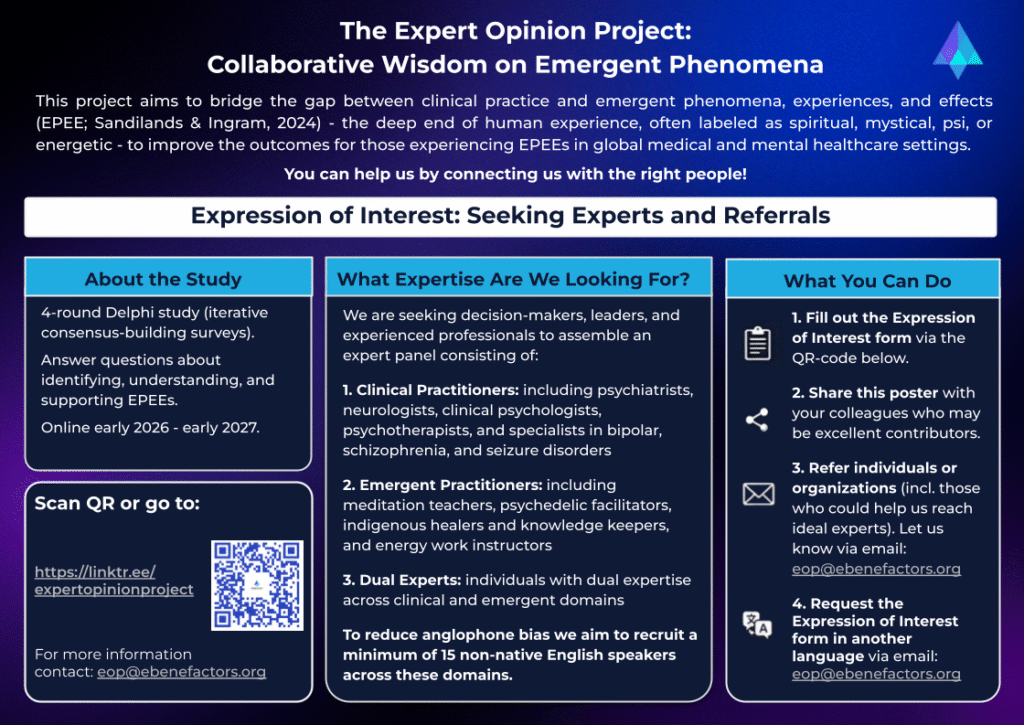
Emergence Benefactors is seeking experts for a Delphi consensus study developing practical guidelines for emergent phenomena, experiences and effects (EPEEs) and their intersection with mental health care, building upon the foundation established in their recently completed pilot study.
What are EPEEs? These are experiences that can go beyond ordinary waking states: energy-like body sensations, unusual perceptual phenomena (lights, visions, altered hearing), shifts in sense of self or reality, ontological shock, deep absorptive or mystical states, and intense emotional processing. They can arise through meditation, psychedelics, breathwork, energy practices, or spontaneously, and they don’t fit neatly into existing standard diagnostic categories.
A key problem we’re trying to solve is that without clear guidance, clinicians may pathologize this class of experiences with psychiatric labels. Equally, genuine medical conditions may be missed when attributed to “spiritual emergence” or similar. To achieve this, we’ve designed a study that uses a structured Delphi process to bring clinical, contemplative, traditional, and cross-cultural perspectives into dialogue, aiming to build collaborative wisdom about understanding and supporting people experiencing EPEEs.
We’re specifically seeking people with professional or practice-based expertise in supporting others through EPEEs, whether through clinical practice, traditional healing, contemplative guidance, facilitation, or other therapeutic approaches. We are aiming to recruit ~60 experts with 10+ years of therapeutic or support-oriented experience, across three clusters:
-
Clinical: Medical and mental health providers experienced with unusual presentations, including psychiatrists, neurologists, clinical psychologists, psychotherapists, and specialists in bipolar, schizophrenia, and seizure disorders
-
Emergent practice: Meditation teachers, psychedelic facilitators, indigenous healers and knowledge keepers, energy work instructors, and guides from traditions involving EPEEs
-
Bridge: Substantial experience across both clinical and emergent practice domains
Note: English language proficiency is not a requirement for participation. Other languages – Spanish, Brazilian Portuguese, and Arabic – can be accessed via Linktree or the QR code above.
What’s involved:
-
4 survey rounds over 12 months (April 2026 – May 2027)
-
~90 minutes per round
-
Flexible format: written survey, audio recordings, or live interview
-
Multilingual options available
-
$150/round ($600 total for full participation)
Interested? Complete the Expression of Interest form (5–10 minutes).
Selected participants will receive detailed study recruitment information and a consent form before study participation begins.
We welcome referrals, please share with colleagues who may qualify.
About this study
This research is conducted by Emergence Benefactors, a 501(c)(3) nonprofit, with funding from the Robert Wood Johnson Foundation’s Ideas for an Equitable Future program. The views expressed here do not necessarily reflect the views of the Robert Wood Johnson Foundation. Approved by Solutions Institutional Review Board (#0984).
For questions, please contact eop@ebenefactors.org
