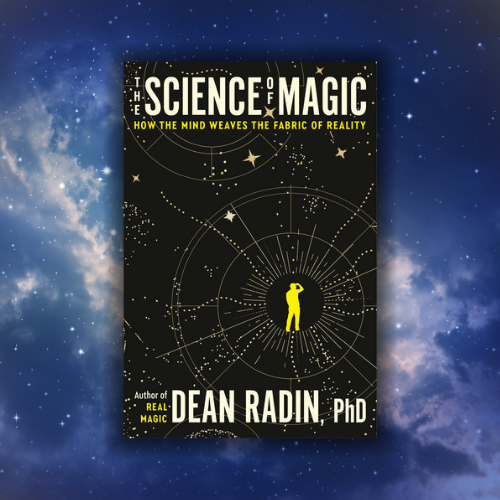
Enjoy this excerpt from The Science of Magic: How the Mind Weaves the Fabric of Reality
Preface
There. Did you feel the ground shake?
No, it wasn’t an earthquake. What you just experienced is a radical paradigm shift—a scientific reconsideration of the role of consciousness in the physical world. Major paradigms in science don’t change very often; they prefer to sit around like curmudgeonly custodians of conventional wisdom, scoffing at new ideas. But when those ideas do start to slide, confusion erupts, experts bicker, and skeptics start to sweat. When the dust settles, a new paradigm takes shape. Then what?
Then we live in a new world.
One of the consequences of this new world is that the esoteric practice of magic will emerge from the shadows, where it has been quietly simmering for about five hundred years. But this time magic, sometimes spelled magick to distinguish it from magic tricks, will be seen through the lens of science. Societal taboos that long suppressed this natural capacity will begin to dissolve, and new light will shine on who we are and what we’re capable of.
This worldview shift is so radical that when a stranger asks me what I do for a living, I’ve learned that there’s some risk in admitting that I study magic. So I just say I’m a scientist. If asked what kind of scientist, I’ll say it’s a little complicated and offer them an answer via a puzzle. I’ll describe where I’ve published articles, and then they can guess what I do. It’s like a game show, but without the fabulous prizes.
If they’re open to this game, I’ll say that I’ve published a few hundred articles in scientific journals, including Foundations of Physics, Frontiers in Human Neuroscience, and Nature Translational Psychiatry. I’ve also served as a referee for two dozen other journals, including Psychological Bulletin, Integrative Cancer Therapies, and Nature Scientific Reports.
If they haven’t stifled a yawn yet, I’ll add that I’ve given about eight hundred invited presentations around the world, including at universities like Harvard, Stanford, Princeton, Columbia, and Cambridge; for U.S. government organizations like the Naval War College, the Naval Postgraduate School, the Army Special Operations Command, and the National Academy of Sciences; for companies like Google and Merck; and for government programs and agencies in Australia, India, and Malaysia. At this point, the listener thinks I’m either a genius or completely full of it.
If they’re not backing away slowly, I’ll add that for over two decades I’ve worked at a research institute founded by the sixth man to walk on the moon. Yes, the actual moon, not a soundstage in Hollywood. I also worked on a formerly classified program charged with investigating exotic methods for gathering intelligence data. Then I’ll ask, What do you think I do? The trick is, whatever they say, I’ll say Yes, that’s it! They feel satisfied because everyone likes to solve a puzzle, and I feel relieved because I can avoid explaining what I do.
I’m reluctant to say that I study magic and its close cousin, psychic phenomena (psi for short), because I know that these topics conjure Hollywood stereotypes. Paranormal-themed horror films have so thoroughly enchanted the modern mind that it’s practically inconceivable that a scientist would take such phenomena seriously.
And yet a majority of the general population, including a surprisingly large percentage of scientists, have had personal experiences that can best be described as magical or psi. Unfortunately, the taboo about these topics is so powerful that we quickly learn not to talk about them. And we certainly don’t chat about magic in the academic world, unless it’s about stage magic or why people believe in silly superstitions.
As of this writing, I’ve been studying psi and magical phenomena for about forty-five years, mostly full time as a scientist in major university, industrial, and private research institutions. I’ve also served five terms as the president of the Parapsychological Association, an international organization for scientists and scholars engaged in the serious study of psi phenomena. Since 1969 the Parapsychological Association has been an elected affiliate of the American Association for the Advancement of Science (AAAS), the largest and most prestigious scientific society in the world. For an organization to become an affiliate, the AAAS council, some 30 representatives of mainstream science, must elect it. As of 2025, the Parapsychological Association is one of 273 AAAS affiliates.
Perhaps in recognition of parapsychology’s scientific status, in April 2024 one of my books was included in a feature article by the Times of India news service. The article listed eight books the Times selected that would “change the way you look at the universe.” It included works by the authors Albert Camus, Friedrich Nietzsche, Fyodor Dostoyevsky, and Franz Kafka, and by physicists David Deutsch and Stephen Hawking. My book on that list was Entangled Minds, which focuses on the physics of psi.
As I was writing that last sentence, something caught my eye. I looked out the window just as a blue commercial van drove by with the word magic emblazoned on the side. The van was part of a fleet for a plumbing company whose motto is “Service so good you’ll believe in magic.” One of its core values is “Get shit done,” which seems apt given its area of expertise.
The synchronicity of writing about magic as the word magic appears outside your window is a sign that we’ve entered a zone where the laws of physics turn into mere suggestions. One of the more celebrated physicists of the twentieth century, John Archibald Wheeler, put it this way: “Useful as it is under everyday circumstances to say that the world exists ‘out there’ independent of us, that view can no longer be upheld. There is a strange sense in which this is a ‘participatory universe.’”
In such a universe, Wheeler emphasized that physical laws are not fixed but rather are, as he put it, malleable. In his famously pithy style, he noted, “There is no law except the law that there is no law.”
Wheeler’s quip was strangely similar to the catchphrase of the notorious occultist Aleister Crowley, who said: “Do what thou wilt shall be the whole of the Law.” This is not to say that Wheeler and Crowley were bosom buddies, because they barely existed in the same universe. On the other hand, is it a meaningful synchronicity?
Let’s get shit done and find out.
Part 1
A Revolution is Brewing
Some say magic is a legendary power that can bend destiny at will.
Modern minds are naturally skeptical about such claims. Science tells us that magic is wishful thinking. It violates the laws of physics. It’s fantasy. No educated person could take it seriously.
But it turns out that magic is quite real and has been hiding in plain sight. Today, through the bright light of science, we can see and begin to
understand magic in new ways.
Part I of this book provides an overview of the magical revolution that’s actively brewing in science. Part II reviews a small but relevant selection of the scientific evidence supporting the reality of magic. Part III discusses how to understand magic from a modern perspective. And Part IV explains how to do magic.
Chapter 1: Introduction
There may be no such thing as the “glittering central mechanism
of the universe” to be seen behind a glass wall at the end of the
trail. Not machinery but magic may be the better description of
the treasure that is waiting.
— JOHN ARCHIBALD WHEELER
In a series of invited lectures to a special study group at the Naval War College, one of the topics I discussed was the scientific evidence for telepathy—direct mind-to-mind communication. During a break, two submarine commanders approached me and described a strange episode they had independently experienced. While under maneuvers and submerged at classified depths, a crew member in each commander’s sub urgently requested that they surface so they could call home. They were certain that something bad was happening in their family. The commanders replied that after their undersea exercises were completed, then they could contact their families.
Each sub surfaced days to weeks later, and in both cases, it turned out that something upsetting had indeed happened in their family at the time that each crew member made their request. Importantly, both commanders noted there were no false positives; that is, these were the only times any crew member had asked to surface early. A typical operational depth for a submarine is 150 to 300 meters, and based on the commanders’ remarks, these subs were likely at the deeper end of that range. At such depths, the only way to receive a signal from the surface world is through extremely low-frequency electromagnetic transmissions, which require antennas tens to hundreds of kilometers long. The rate of these transmissions is only about one letter per minute. Even if a human brain could detect and decode such messages (which is exceedingly unlikely), those transmissions are used solely for military purposes. They aren’t used to send personal messages to crew members about their families. Moreover, submariners are carefully selected for their exceptional mental toughness, resilience, and emotional flexibility—not the type of person you’d expect to report a fanciful telepathic experience while deep underwater. But they do.
You may have experienced something similar—a time when you just knew that something unexpected was happening to a loved one at a distance, and later you discovered you were right. Or you found yourself thinking about an old friend and soon received a call or an email from them. In fact, two nights before writing this passage, I had a dream about a friend from summer camp, over fifty years ago. Out of the blue, “Joan” showed up in my dream. I hadn’t thought about her in years. The next morning I received a blind-copied email from Joan, which prompted me to write back and ask why I was suddenly included in her mailing list. She explained that her realtor had mentioned Edgar Mitchell—an Apollo 14 astronaut—and that Edgar had talked about the noetic sciences. Because I work at the Institute of Noetic Sciences, which Mitchell founded in 1973, Joan thought of me. That night I dreamed about her.
Because of commonly reported experiences like this, most people, including scientists, quietly maintain some belief in psychic and magical phenomena. At the same time, mainstream science insists that these phenomena can’t exist because the mind is solely a product of brain activity, so everything having to do with mental activity, including consciousness, is locked inside our skulls. End of story.
But there’s a problem with that story. Psychic and magical experiences are frequently reported, and they require that consciousness somehow transcends the brain and extends into the physical world. Until about five hundred years ago, most people believed that consciousness was fundamentally interconnected with the physical world, and from that perspective the existence of psychic effects like telepathy and magical effects like divination was taken for granted. Then, as science became the dominant way of understanding reality, magic fell out of favor, and generations of students were trained to see reality solely through the lens of materialism, the philosophical assumption that everything, including consciousness, is made of matter and energy. That worldview has become so entrenched in our way of thinking about reality that science textbooks don’t bother to mention that nearly all the physicists who developed quantum mechanics believed that consciousness played a key role in the physical world. Some, like Max Planck, believed that consciousness was the only primary reality.
But science marches on, and we are now in the midst of a remarkable period of remembering what our forebears knew. Science is rediscovering magic.
About This Book
This book is about the science, theory, and practice of real magic. These practices come in three flavors: enchantment, divination, and theurgy. Enchantment is the ability to mentally modulate aspects of the physical world and shape destiny. Divination involves perceptions that transcend the everyday limits of space and time. Theurgy is about spirits and spiritual development.
Magic, like meditation or mathematics, is a mental skill. Anyone can learn some of the key elements, but true mastery requires practice and natural talent. Magical practices can be found throughout history and in all cultures. Among the thousands of books about magic, only a small percentage discuss this topic from a scientific perspective. And most of those address magic in terms of tricks and illusions, or mistaken beliefs about magic, or the malleable brain-body relationship. Only a handful of books about real magic have been written by scientists.
Who Is This Book For?
This book’s subtitle, “How the Mind Weaves the Fabric of Reality,” refers to the emerging scientific recognition of the role that consciousness plays in the behavior of the physical world. This perspective transforms psychic, mystical, spiritual, and magical experiences from weird and rare brain-centric hallucinations into predictable and commonly reported mind-oriented experiences.
I am confident that we’ll eventually have a rational, scientifically satisfying explanation for magic. The most prominent physicists of the nineteenth century couldn’t have imagined how much the laws of physics would be revised by the turn of the twentieth century. Nor could the most accomplished scientists at the beginning of the twentieth century have anticipated how much the meaning of the term reality would be transformed by the early decades of the twenty-first century. History provides endless examples of leading intellectuals whose prognostications about future discoveries were laughably wrong in hindsight. Each new generation insists that now we’re finally modern and sophisticated, and so now we’re absolutely positive that this or that is impossible. I believe it is likely that by the dawn of the twenty-second century, our scientific understanding about mind and its relationship to matter will have evolved to the point where what we currently call “magic” will be accepted as self-evident.
Today’s leading edge in physics already proposes that spacetime is an emergent property of quantum entanglement, which is “outside” space and time. In the future we may discover that mind, matter, energy, space, and time—concepts once thought to be entirely separate features of reality—actually emerge from a single source that is none of those concepts but somehow all of them and more. At that point a scientific theory of everything will begin to catch up with the esoteric worldview, in which the physical world emerges from a primordial form of consciousness and its two primary qualities: awareness, meaning first-person subjective experience, and agency, the ability to freely choose and act.
What This Book Is Not About
Many experiences might seem like magic, but they’re not. With 8 billion people on this planet, and each of us having a thousand or more unique experiences every day, a few extremely unlikely coincidences will always occur by chance. Some of those coincidences will be told and retold, giving the impression that we’re awash in magic and miracles. Other amazing experiences will be told in hushed tones, but some of them will be mistakes of memory, wishful thinking, or fabricated to gain attention. It would be foolish to believe that all tales of magic are true, and just as foolish to believe that none of them are true. As the mathematician and physicist Henri Poincaré put it: “Doubt everything or believe everything: These are two equally convenient strategies. With either we dispense with the need for reflection.”
How do we know, then, what’s true in principle about magic? The approach my colleagues and I have taken is to test the claims of psi and magic using the tools of science. Science is not perfect, but it is the most powerful way we currently have for sifting the magical wheat from the mundane chaff. For ethical reasons, scientific methods also impose constraints on the ways we can safely study human abilities, so what we observe in controlled laboratory studies is typically much weaker than magic as it’s expressed in the everyday world. But scientific tests also give us greater confidence that the effects we do see are not due to a dozen ordinary things that might seem like magic.
After you finish reading this book, it’s important to take a step back and take a deep breath. If you start to hear dark omens issued by every raven that happens to fly by, then stop listening to the birds for a while. Challenging your worldview is healthy, but it can take time to reintegrate your belief system with the knowledge that magic is quite real. So before you quit your job, sell all your belongings, don the leathers and feathers of a shaman, and retreat to a bunker in the woods, relax with your newfound knowledge that magic was always here. It’s not something brand-new that just dropped out of the sky. If after a few months the forest and the ravens are still calling you, then go for it. But it might be prudent to put your belongings in storage and get a satellite phone.
Shortly after I wrote the above passage, my wife and I took a walk around our neighborhood and encountered two ravens. One made a strange wooden knocking sound, like the wood block instrument you’d find in a percussion section of an orchestra. Both ravens were clearly watching us. Years before, I’d spotted a wild raven, but I hadn’t seen any in recent memory. In mythology, ravens are messengers between the earthly and spiritual realms. What this raven’s message was, I don’t know. Maybe it was recommending a satellite phone.
Normalizing the Paranormal
If you wanted to find out about near-death experiences, you had to go to the back of the bookstore. You know, where they have witchcraft and magic and other esoteric things. But now, over the last ten to fifteen years, many of these things are beginning to be mainstreamed and normalized.
— Neuroscientist Christof Koch, during a plenary talk at the Science of Consciousness Conference, Tucson, Arizona, April 2024
Entrenched prejudices that have long relegated real magic to the metaphysical permafrost are slowly melting. The emerging worldview is known in the esoteric traditions as the “perennial philosophy.” It’s the idea that reality is fundamentally mental. Philosophers call this worldview idealism. Idealism is at the core of Western esoteric traditions like Hermeticism and Neoplatonism and of Eastern esoteric traditions like Advaita Vedanta. It is also increasingly found across a broad array of scientific and scholarly disciplines.
In idealism, the physical world is regarded as a mere appearance created by consciousness. A common critique about this idea is that it suggests the moon isn’t there if nobody looks at it. But idealism doesn’t insist that reality is created only by human consciousness. There may be a cosmic or universal consciousness that is always “looking” at everything.
The shift toward taking consciousness seriously in science was sparked and then accelerated by advances in the neurosciences, the renaissance of psychedelics research, the mainstreaming of meditation, and an unresolved enigma about the role of the observer in physics. As the neuroscientist Christof Koch put it:
The wheel is turning back to much more ancient understandings of experience, including idealism, the proposition that ultimately even matter and energy are mental manifestations, and panpsychism, the school of thought that all creatures, and perhaps even matter itself, are ensouled, that it feels-like-something to be anything, not just a human or even a bat. Modern science is supporting aspects of this remarkable turn of events.
Such ideas are no longer found in obscure journals and starry-eyed New Age magazines. They’re found in practically every issue of the popular science press, including New Scientist, Discover, and Scientific American. Even intensely fierce critics of the paranormal are changing their tune, perhaps without realizing it.
For example, Richard Dawkins is an evolutionary biologist and crusading atheist who coined the term meme and authored books like The God Delusion. He is also a fellow of the Committee for Skeptical Inquiry, which for decades has enthusiastically vilified parapsychology as a pseudoscience. With that background, Dawkins said something quite unexpected in a 2020 podcast interview with popular podcaster Lex Fridman:
I have thought about using Nick Bostrom’s idea [that we are living in a simulation] to solve the riddle of how the human brain [can] achieve so much. I thought of this when my then hundred-year-old mother was marveling at what I could do with a smartphone. I could look up anything in the encyclopedia, I could play her music she liked, and so she said is all that in that tiny little phone? No, it’s out there. It’s in the cloud, and maybe what we do is in the cloud. . . . [We] interface with something else, like what Roger Penrose [proposes] with panpsychism, that consciousness is somehow a fundamental part of physics, that it doesn’t have to actually all reside inside the brain. But Roger thinks it does reside inside the skull, whereas I’m suggesting that it doesn’t.
The implications of the mind not residing inside the brain seem to have escaped Dawkins’s attention, because it’s exactly what the philosopher and 1927 Nobel laureate Henri Bergson proposed as the “filter theory” of consciousness. Bergson said the brain doesn’t create or store memories; rather, memories are nonmaterial and are retrieved only when they’re required, from elsewhere. Incidentally, in 1913 Bergson was the president of the London-based Society for Psychical Research (SPR). Founded in 1882, the SPR was the first professional organization devoted to the systematic scientific study of psi (psychic) phenomena.
Prominent philosopher David Chalmers described the renewed interest in consciousness as follows: “One starts as a materialist, then one becomes a dualist, then a panpsychist, and one ends up as an idealist.” He explained this sequence by noting that graduate students interested in the relationship between mind and matter evolve through four phases. First, the student is impressed by the successes of science, endorsing materialism about everything and also about the mind. Second, one is moved by the problem of consciousness to see a gap between physics and consciousness, thereby endorsing dualism, where both matter and consciousness are fundamental. Third, one is moved by the inscrutability of matter to realize that science reveals at most the structure of matter and not its underlying nature, and to speculate that this nature may involve consciousness, thereby endorsing panpsychism. Fourth, one comes to think that there is little reason to believe in anything beyond consciousness and that the physical world is wholly constituted by consciousness, thereby endorsing idealism.
Magic and Psi
You’ve noticed by now that I use the terms magic and psi interchangeably. That’s because these words are reflections of the same phenomenon. We might think that telepathy (mind-to-mind connections) is entirely different from clairvoyance (perceiving through space and time), but both are just different ways we experience—jargon alert—nonlocal consciousness. Nonlocal consciousness is a euphemism that’s gaining traction in academia. It refers to an aspect of awareness that is not constrained by ordinary space or time, and through which focused intention can directly interact with properties of the physical world. In other words, magic.
While magic and psi are facets of the same phenomenon, the history and methods of these two realms differ. Magical beliefs and practices are deeply entwined with indigenous spiritual and orthodox religious traditions. The history, methods, and culture of psi research are more limited, partly because as a discipline it is relatively new, and partly because psi research is a secular academic pursuit that intentionally strips away any occult, spiritual, religious, and supernatural connotations.
Viewed from the earthy, hot, and wild perspective of magic, psi research is impossibly cold and stuffy, like magic for nerds. Magic promises leather-bound cosplay with world-shattering sex and drugs. Psi offers a glimpse at statistical peculiarities that excite subversive academics who may have read about sex and drugs in a journal article but are otherwise unfamiliar with those concepts.
While these traditions may be wildly divergent, magicians (meaning those who seriously practice magical techniques) largely agree with psi researchers that magic rarely produces “big” effects, like those in magic-themed action or horror films. Psi effects observed in the laboratory and magical outcomes in the real world are often subtle and manifest as meaningful synchronicities. On the flip side, some spontaneous psi effects, like poltergeist episodes, can be quite impressively “big,” and occasionally even a controlled laboratory outcome will raise eyebrows.
That magic and psi point at the same phenomena is not a new idea. Jane Roberts, the channeler for the entity known as Seth, wrote: “We were immersed in ‘magic’ no matter what we called it . . . manifestations of telepathy, and so forth, were just places where our magic ‘showed.’” Magicians, too, have noted the connection. Isaac Bonewits, in his book Real Magic, wrote that “almost any phenomenon in magic can be given a name that can be fitted into the field of parapsychology, regardless of whether the parapsychologists or magicians appreciate the fact.” The chaos magic pioneer Peter J. Carroll, in presenting his “Equations of Magic” in Liber Kaos, described his equations as “three formulae which describe the necessary ingredients of any spell or ritual designed to have parapsychological effect.”
One of the differences between psi and magic was noted by Carroll, who wrote: “I always caution against trying to ‘prove’ the existence of magic by participating in laboratory parapsychology experiments. They will almost certainly fail anyway because the experimenters set the conditions to strongly favour failure.” The occultist Julian Vayne agreed: “Psychic ability has been demonstrated time and again in parapsychological laboratories all over the world. . . . Go and read some of the (generally rather dull) experiments if you don’t believe me—yes, people are psychic. So that’s magick. . . . Well, yes and no! Yes, this kind of effect is part of what magick is but no, that’s not the whole story.”
The magician J. Finley Hurley, in his book Sorcery, devoted many pages to psi research. But again echoing Carroll’s and Vayne’s comments, he noted that the psychiatrist Jan Ehrenwald, who had extensively studied how psi is expressed in the everyday world, said that in the laboratory “psi phenomena are in effect derivatives of magic that have been dehydrated, de-boned, and filleted to make them digestible for scientific consumption.”
What magicians and those who study “psi in the wild” are referring to are the ethical constraints placed on the methods that researchers are allowed to use. If we gave participants powerful psychedelic drugs and then did the laboratory equivalent of pushing them off a cliff, we’d probably see some pretty impressive psi. But, of course, we can’t do that, so we’re limited to studying weak magic. Still, factors said to enhance magical efficacy—like belief, motivation, desire, and imagination—are also found in psi research, so we know we’re studying the same underlying phenomena.
